TDLR Licensed MAC #1963 · Independent · No Remediation Conflict
Schedule a Free Consultation - Call 832-280-4747
<span>Licensed Mold Testing & Inspection in The Woodlands, TX</span>
Call to Schedule 832-280-4747<a href="tel:8322804747">📞<span>Licensed Mold Testing & Inspection in The Woodlands, TX</span>
<a href="tel:8322804747">📞 832-280-4747 — Free
CIRS & HERTSMI-2 Mold Testing | Mold Consultant Group
CIRS from mold exposure? Learn how HERTSMI-2 scoring determines if your home is safe. Licensed mold assessor serving The Woodlands & Montgomery County TX.
MOLD ASSESSMENT & TESTING
Brian Boone
5/28/20267 min read
CIRS and Mold: Understanding Chronic Inflammatory Response Syndrome and the HERTSMI-2 Score
By Mold Consultant Group | TDLR Licensed MAC #1963 | Serving The Woodlands, Spring, Conroe & Montgomery County, TX
If you or a family member has been struggling with a constellation of unexplained symptoms — fatigue, cognitive difficulties, chronic sinus issues, joint pain, and sensitivity to light or sound — and your conventional medical workup has come back normal, a physician may have raised the possibility of Chronic Inflammatory Response Syndrome, or CIRS. For patients navigating a CIRS diagnosis, understanding what's in their home environment isn't just a health preference — it's a clinical necessity.
This post explains what CIRS is, how mold exposure relates to it, and how a specific environmental testing protocol — the HERTSMI-2 score — is used to evaluate whether a home is safe for CIRS patients to occupy.
What Is CIRS?
Chronic Inflammatory Response Syndrome (CIRS) is a multi-system, multi-symptom illness caused by exposure to biotoxins — naturally occurring toxic substances produced by certain organisms. The most common source of indoor biotoxin exposure is water-damaged buildings harboring mold species that produce mycotoxins and other inflammagens.
CIRS was identified and described by Dr. Ritchie Shoemaker, a physician whose research beginning in the 1990s established the biological mechanism by which certain genetically susceptible individuals fail to clear biotoxins from their bodies. While the general population can process and eliminate most biotoxin exposures without lasting health effects, an estimated 24% of the population carries a specific HLA-DR genetic variant that impairs this clearance pathway.
For individuals with this genetic susceptibility, continued biotoxin exposure — particularly from water-damaged building molds — triggers a sustained inflammatory cascade that affects multiple body systems simultaneously. Unlike a simple allergic reaction, CIRS involves dysregulation of inflammatory pathways, hormonal systems, and neurological function that persists long after the initial exposure is removed.
The Biotoxin Pathway: Why Mold Affects Some People More Than Others
Understanding why CIRS affects some people and not others requires a brief look at the biology involved. In most people, biotoxins from mold are processed by the immune system and cleared from the body via normal detoxification pathways. The symptoms of mold exposure in these individuals, while real, are typically temporary and resolve when the exposure source is removed.
In genetically susceptible individuals, this clearance mechanism is impaired. Biotoxins recirculate rather than being cleared, continuously stimulating the innate immune system. This sustained activation produces a cascade of downstream effects:
• Elevated levels of MMP-9 (Matrix Metalloproteinase-9) — an inflammatory marker that damages connective tissue
• Suppression of MSH (Melanocyte-Stimulating Hormone) — a regulatory peptide that controls pain, sleep, gut motility, and immune function
• Dysregulation of ADH (Anti-Diuretic Hormone) — producing symptoms of excessive thirst and frequent urination
• VEGF (Vascular Endothelial Growth Factor) suppression — reducing oxygen delivery to tissues and contributing to fatigue
• TGF-beta-1 elevation — an immune regulatory protein whose elevation is associated with autoimmune activity
• Neurological effects — including cognitive impairment, word retrieval difficulties, and what CIRS patients describe as 'brain fog'
These are measurable laboratory findings, not subjective complaints. The Shoemaker Protocol uses a sequence of blood tests to identify each of these markers and track treatment response.
Common Symptoms of CIRS From Water-Damaged Buildings
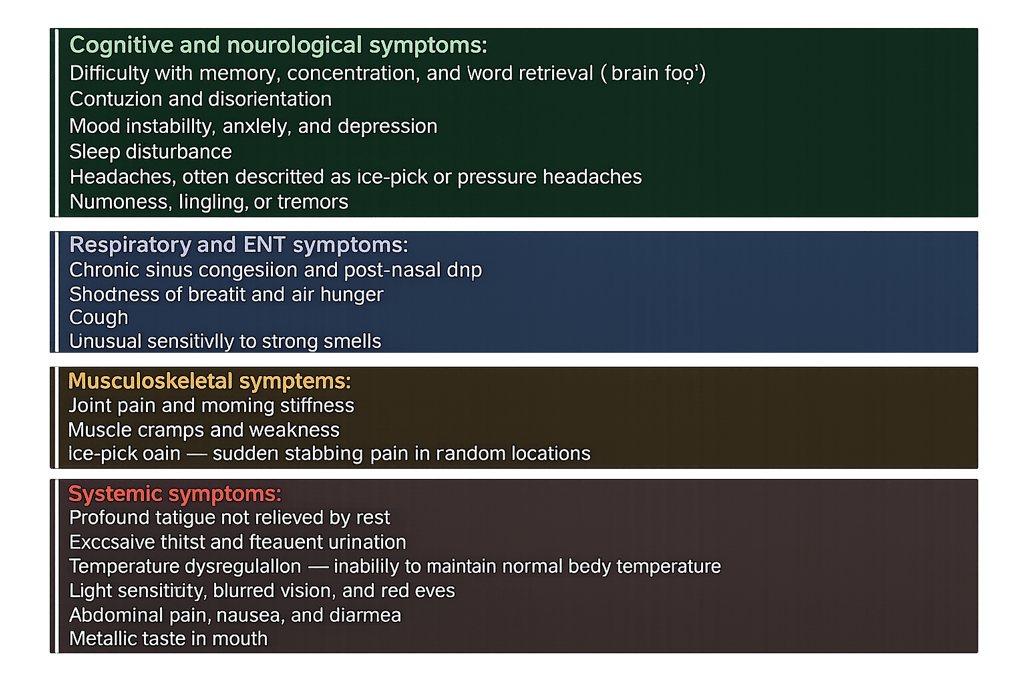
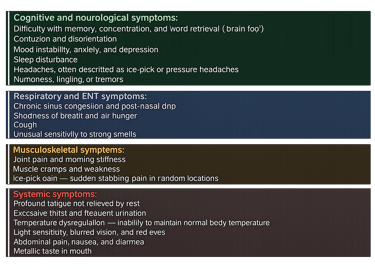
The symptom profile of CIRS is broad and variable — which is one reason it is frequently misdiagnosed or dismissed. The Visual Contrast Sensitivity (VCS) test, a neurological assessment of visual function, is a validated screening tool for biotoxin illness that can be self-administered online. Common CIRS symptoms include:
The Role of Environmental Testing in CIRS Treatment
The Shoemaker Protocol — the evidence-based treatment framework for CIRS — makes environmental remediation a prerequisite for clinical recovery. This is a fundamental point: CIRS patients cannot fully recover while continuing to be exposed to the biotoxin source. Medical treatment without environmental remediation produces temporary improvement followed by relapse.
This creates a specific clinical need: CIRS patients and their treating physicians need to know not just whether a home has elevated mold counts in general, but whether the specific mold species present are the ones most associated with CIRS and biotoxin illness. Standard mold air sampling provides valuable information, but CIRS treatment protocols require a more targeted assessment — which is where the HERTSMI-2 score comes in.
What Is the HERTSMI-2 Score?
HERTSMI-2 (Health Effects Roster of Type-Specific Formants for Mycotoxins and Inflammagens — 2nd version) is a scoring system developed specifically for evaluating whether a building environment is safe for CIRS patients. It was developed as a simplified, clinically relevant subset of the broader ERMI (Environmental Relative Moldiness Index) test.
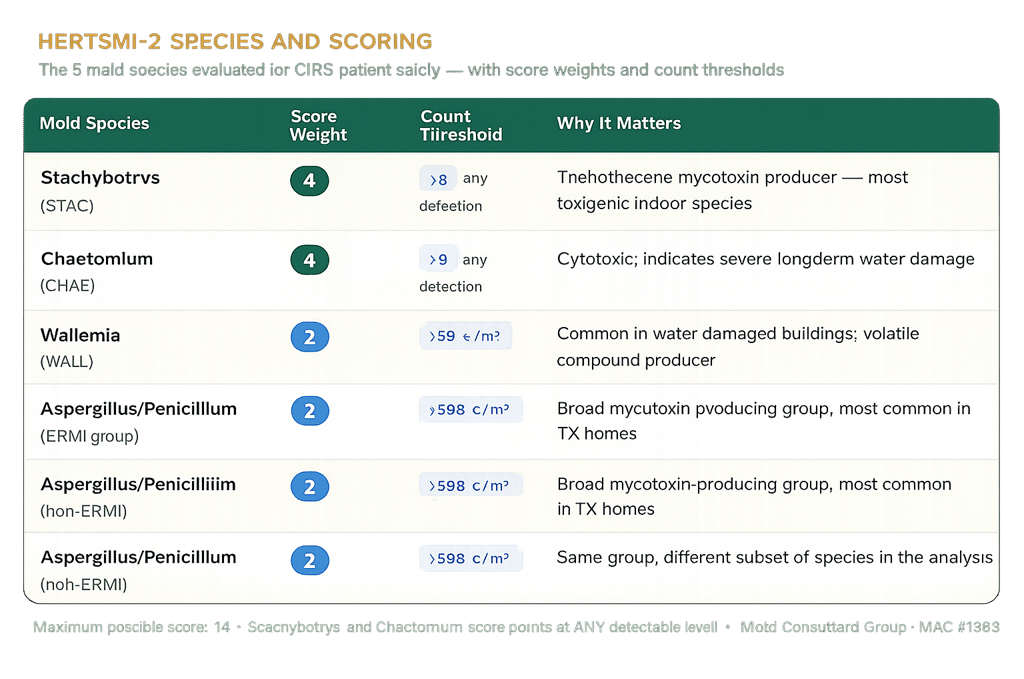
Where the full ERMI test measures 36 different mold species and produces a relative moldiness index for the building, the HERTSMI-2 focuses on just 5 specific species that are most strongly associated with biotoxin illness and CIRS:
HERTSMI-2 Species and Scoring:
Each species is scored based on whether its concentration exceeds a threshold level. The scores for all five species are added together to produce the total HERTSMI-2 score.
How to Interpret Your HERTSMI-2 Score
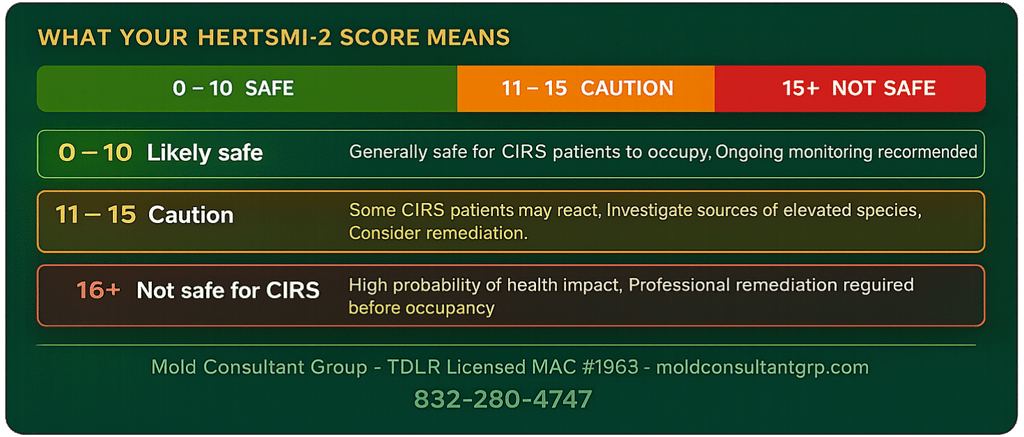
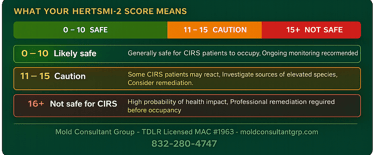
The HERTSMI-2 score is interpreted using thresholds established through clinical research with CIRS patients:
It's important to understand what these thresholds represent: they are not thresholds for the general population but specifically for CIRS patients — individuals who are genetically unable to clear biotoxin exposures normally. A home that scores in the 'caution' or 'not safe' range may not produce noticeable symptoms in occupants who don't have the susceptible HLA-DR type, while producing significant ongoing illness in a CIRS patient.
HERTSMI-2 vs. Standard Air Sampling — What's the Difference?
Standard professional air sampling — the type we perform at Mold Consultant Group — collects airborne spore samples and identifies species by microscopy, comparing indoor counts to an outdoor baseline. This method provides a comprehensive picture of the indoor mold environment and is the foundation of professional mold assessment in Texas.
Standard air sampling is ideal for: General mold assessment, identifying elevated conditions, guiding remediation scope, post-remediation clearance testing, real estate transactions, and insurance claims.
HERTSMI-2 testing is ideal for: CIRS patient re-entry assessment — determining whether a home that has been remediated, or a new home being considered, is safe for a CIRS patient to occupy. It answers a specific clinical question rather than providing a general environmental assessment.
HERTSMI-2 testing requires dust sampling rather than air sampling — a settled dust sample is collected from specific locations in the home and sent to an ERMI-certified laboratory for DNA-based analysis (MSQPCR — Mold-Specific Quantitative Polymerase Chain Reaction). This method quantifies the actual mold DNA present in settled dust, which represents the cumulative mold burden in the home over time rather than a point-in-time airborne snapshot.
The ERMI Test and Its Relationship to HERTSMI-2
The ERMI (Environmental Relative Moldiness Index) was developed by the EPA to assess the relative moldiness of homes. It uses the same MSQPCR DNA analysis as HERTSMI-2 but measures all 36 species in the original EPA panel rather than just the 5 CIRS-relevant species.
HERTSMI-2 scores can be calculated from ERMI test results — the 5 HERTSMI-2 species are a subset of the 36 ERMI species. Many CIRS-treating physicians request a full ERMI test from which the HERTSMI-2 score can be extracted, providing both the comprehensive ERMI index and the CIRS-specific HERTSMI-2 score from a single sample.
What CIRS Patients and Their Families Should Know About the Houston Area
The Houston area and Montgomery County present a specific challenge for CIRS patients and their treating physicians. Our climate — subtropical humidity, frequent flooding, and a housing stock substantially affected by Harvey and subsequent water events — means the prevalence of the mold species most associated with CIRS (Stachybotrys and Chaetomium in particular) is higher here than in drier climates.
Stachybotrys chartarum requires sustained, significant moisture to grow — exactly the conditions produced by flood events and chronic HVAC condensation issues in our region. Chaetomium similarly indicates severe or prolonged water damage. These are the two highest-weighted species in the HERTSMI-2 scoring system, and they are species we encounter regularly in assessments throughout The Woodlands, Spring, Conroe, and surrounding communities.
For CIRS patients attempting recovery in the Houston area, working with a treating physician who understands the local environmental context — and with a licensed mold assessor who can provide both standard air sampling and guidance on HERTSMI-2 testing — is essential.
How Mold Consultant Group Supports CIRS Patients and Their Physicians
We work with CIRS patients and their treating physicians throughout The Woodlands, Spring, Conroe, Magnolia, Montgomery, and surrounding communities. Our assessments for CIRS-related evaluations typically include:
• Comprehensive visual inspection with particular attention to the HERTSMI-2 species' preferred growing locations — long-term water-damaged areas, HVAC systems
• Standard air sampling with species identification — providing both a general environmental assessment and identification of the HERTSMI-2 species in air counts
• Moisture mapping and infrared thermal imaging — identifying hidden moisture sources that may be sustaining Stachybotrys or Chaetomium growth
• Guidance on ERMI/HERTSMI-2 dust sampling — we can advise on collection protocols and accredited laboratories for MSQPCR analysis
• Written assessment reports structured to be useful to treating physicians — documenting findings in a format that supports clinical decision-making
• Post-remediation verification — confirming that remediation has reduced HERTSMI-2 species to acceptable levels before a CIRS patient re-enters the home
We are not CIRS treating physicians and we do not diagnose or treat CIRS — that is the domain of the medical professionals working with your specific case. Our role is to provide accurate, professional, independent documentation of the environmental conditions that your physician needs to guide treatment decisions.
Finding a CIRS-Treating Physician
If you believe you or a family member may have CIRS, the Surviving Mold website (survivingmold.com) maintained by Dr. Shoemaker provides a directory of certified practitioners trained in the Shoemaker Protocol. The Visual Contrast Sensitivity (VCS) test available on that site is a free online screening tool that takes approximately 10 minutes and can be a useful first step in determining whether further evaluation is warranted.
A CIRS diagnosis requires specific laboratory testing — the Shoemaker Protocol biomarker panel — and clinical evaluation by a trained practitioner. Environmental testing, including HERTSMI-2 assessment, is part of the treatment protocol but is not a substitute for medical evaluation.
Concerned about mold in your home and its potential connection to chronic illness? Call 832-280-4747. We provide licensed, independent assessments throughout The Woodlands, Spring, Conroe, and all of Montgomery County — and we understand the specific environmental context of the Houston area.
Mold Consultant Group, LLC | PO Box 206, Montgomery, TX 77356 | TDLR Licensed MAC #1963 | IICRC Master Cleaner #266 | Independent — No Remediation Conflict
Note: This article is for educational purposes only and does not constitute medical advice. CIRS diagnosis and treatment requires evaluation by a licensed medical professional trained in the Shoemaker Protocol.
You Might Also Find Helpful:
→ Mycotoxins: What They Are and How They Affect Your Health
https://moldconsultantgrp.com/mycotoxins-what-they-are-and-how-they-affect-your-health
→ Mold Sensitivities in Humans and Pets
https://moldconsultantgrp.com/mold-sensitivities-in-humans-and-pets
→ How to Read Your Mold Lab Report
https://moldconsultantgrp.com/how-to-read-your-mold-lab-report
→ Types of Mold Commonly Found in Houston-Area Homes
Mold Consultant Group
Independent Mold Testing & Iinspection in The Woodlands, TX.
TDLR Licensed MAC #1963.
PO Box 206, Montgomery TX 77356
Company
Hours
Mon–Thu: 9AM–5PM
Friday: 9AM–4PM
Saturday: By Appt
© 2026 Mold Consultant Group, LLC. All rights reserved.
Privacy Policy · Terms of Service · Disclaimer
TDLR MAC #1963 · MRC #0223 · IICRC Master Cleaner #266