TDLR Licensed MAC #1963 · Independent · No Remediation Conflict
Schedule a Free Consultation - Call 832-280-4747
<span>Licensed Mold Testing & Inspection in The Woodlands, TX</span>
Call to Schedule 832-280-4747<a href="tel:8322804747">📞<span>Licensed Mold Testing & Inspection in The Woodlands, TX</span>
<a href="tel:8322804747">📞 832-280-4747 — Free
Limitations of DIY Home Mold Testing Kits vs. Professional Testing
Discover the limitations of DIY Home Mold Testing Kits and learn how professional testing offers accurate results and peace of mind. Explore the numerous benefits of opting for professional testing today!
MOLD ASSESSMENT & TESTING
4/17/20265 min read
Why DIY Mold Testing Kits Fall Short — And What You Really Need
By Mold Consultant Group | TDLR Licensed MAC #1963 | Serving The Woodlands, Spring, Conroe & Montgomery County, TX
Walk into any hardware store in The Woodlands or Conroe and you'll find them on the shelf — DIY mold test kits promising results in 48 hours for $10 to $40. The idea is appealing: if you're worried about mold in your home, why not start with a quick, inexpensive test before calling a professional?
The honest answer is that DIY mold kits are not just limited — they're often misleading. And in a region like ours, where mold is a legitimate year-round concern driven by subtropical humidity and a flooding history, making decisions based on unreliable test results can be costly.
Here's what you need to know before spending a dime on a hardware store mold kit.
How DIY Mold Kits Work — and Why That's the Problem
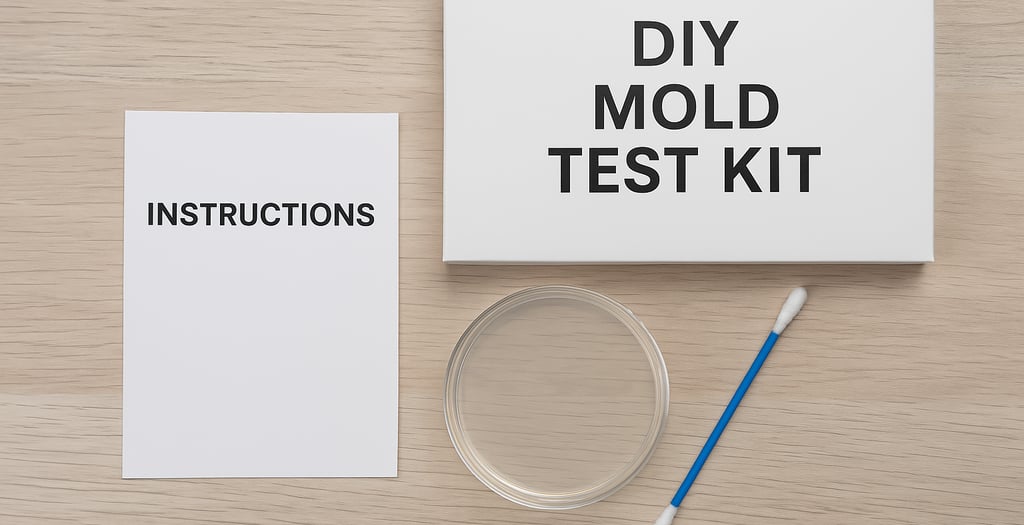
Most DIY mold test kits use a petri dish containing a nutrient-rich growth medium. You leave the dish open in a room for a set period, then seal it and wait 48 hours to see if anything grows. Some kits let you mail the dish to a lab for species identification at an additional cost.
The fundamental flaw is in that process itself: mold spores are present in virtually every indoor and outdoor environment at all times. Leave a petri dish open in any room of any home in Montgomery County and something will grow — every single time. That growth tells you nothing meaningful about whether your home has an elevated mold problem. You'd get the same result in a spotless new construction home as you would in a home with a serious hidden mold issue.
5 Specific Ways DIY Kits Give You Unreliable Results
1. No outdoor baseline comparison. Professional mold assessment always includes an outdoor air sample taken at the same time as indoor samples. The outdoor sample is the baseline — it tells you what's naturally present in the air that day. Indoor counts are only meaningful when compared to outdoor counts. DIY kits have no outdoor baseline, so any result they produce is uninterpretable in isolation. A high indoor count could be normal if outdoor counts are also high that day.
2. They don't measure concentration. The question that matters isn't whether mold spores are present — it's how many are present per cubic meter of air. Professional air sampling uses calibrated pumps that draw a precise volume of air through a spore trap cassette, producing a countable, measurable result. A petri dish sitting open on a table captures whatever settles — it cannot produce a concentration measurement.
3. Gravity-settle sampling misses the most dangerous conditions. The spores that pose the greatest health risk are the lightest and smallest — they stay airborne longer and penetrate deeper into lung tissue. These spores are the last to settle onto a petri dish. A gravity-settle kit will catch heavier, larger spores while missing the very particles most relevant to health assessment.
4. Results are not TDLR-accredited. In Texas, mold assessment must be performed by a licensed Mold Assessment Consultant under TDLR regulations. DIY kit results — even those with mail-in lab analysis — are not performed by a licensed MAC and carry no legal standing. If you're dealing with an insurance claim, a real estate transaction, or a landlord-tenant dispute, DIY results are not usable documentation. You will need a professional assessment regardless.
5. No moisture assessment, no inspection, no protocol. A DIY kit tells you only whether something grew in a petri dish. It cannot identify where mold is growing, what the moisture source is, whether the problem is in your HVAC system or wall cavity, or what needs to be done to fix it. A professional assessment includes visual inspection, moisture readings, infrared imaging when warranted, laboratory-verified air sampling, and a written report with actionable findings. A petri dish gives you none of that.
When DIY Results Create False Reassurance
The scenario we see most often: a homeowner has a musty smell or visible discoloration and buys a DIY kit. The kit shows minimal growth. They conclude the problem is minor and take no further action. Six months later, a professional assessment reveals elevated Aspergillus/Penicillium counts and an active moisture source behind a wall that has been spreading for months.
False negatives from DIY kits are common — and expensive. In the Houston area's climate, a hidden moisture source left unaddressed for an additional six months can turn a $2,000 remediation job into a $12,000 one.
When DIY Results Create False Alarm
The opposite also happens. A homeowner gets significant growth in their petri dish, panics, and contacts multiple remediation contractors who quote aggressive (and expensive) remediation scopes without an independent assessment. Without professional air sampling showing actual spore concentrations, there is no way to know whether what grew in that dish reflects a genuine elevated indoor mold condition or simply normal background spore levels.
Under Texas law, a licensed MAC must assess and write a remediation protocol before a licensed MRC can begin work. A remediation contractor who skips the independent assessment step and goes straight to remediation based on a DIY kit result is not following Texas mold law — and may be doing unnecessary work at your expense.
What Professional Testing Actually Includes
A professional mold assessment from Mold Consultant Group includes:
• Visual inspection of all accessible areas with attention to moisture-prone locations
• Calibrated moisture readings using professional-grade meters on building materials
• Infrared thermal imaging when indicated — identifying hidden moisture behind walls
• Air sampling using industry-standard Zefron spore trap cassettes, analyzed by a TDLR-accredited laboratory
• Outdoor baseline sample taken simultaneously for accurate comparison
• Particulate monitoring using our Extech particle counter
• Detailed written report with laboratory results, findings, and specific recommendations
The difference between that process and a petri dish sitting on a counter isn't just quality — it's the difference between actionable, defensible information and a number that means nothing without context.
The Bottom Line on DIY Kits
If you're concerned enough about mold to spend money testing for it, you're concerned enough to get a result you can actually use. DIY kits are not accredited, cannot measure concentration, have no baseline comparison, and produce results that aren't defensible for insurance, legal, or real estate purposes.
In The Woodlands, Spring, Conroe, Magnolia, and throughout Montgomery County — where mold pressure from humidity, flooding history, and aging housing stock is a genuine year-round concern — a professional assessment is the only tool that gives you information you can act on with confidence.
Call 832-280-4747 for a professional mold assessment. Licensed, independent, TDLR MAC #1963. Results in 24–48 hours.
Mold Consultant Group, LLC | PO Box 206, Montgomery, TX 77356 | TDLR Licensed MAC #1963 | IICRC Master Cleaner #266 | Independent — No Remediation Conflict
Serving Montgomery | The Woodlands | Spring | Conroe | Willis | Tomball | Magnolia | Cypress
📞 Need Accurate, Reliable Mold Testing?
Call 832-280-4747 or schedule an inspection at www.moldconsultantgrp.com
DIY kits can raise questions. We provide answers you can act on — and trust.
This information is provided for educational purposes only. For property-specific recommendations, professional mold testing is recommended.
You Might Also Find Helpful:
→ How to Read Your Mold Lab Report
https://moldconsultantgrp.com/how-to-read-your-mold-lab-report
→ The Importance of Mold Assessment & Testing
→ Mold Myths vs. Facts
Mold Consultant Group
Independent Mold Testing & Iinspection in The Woodlands, TX.
TDLR Licensed MAC #1963.
PO Box 206, Montgomery TX 77356
Company
Hours
Mon–Thu: 9AM–5PM
Friday: 9AM–4PM
Saturday: By Appt
© 2026 Mold Consultant Group, LLC. All rights reserved.
Privacy Policy · Terms of Service · Disclaimer
TDLR MAC #1963 · MRC #0223 · IICRC Master Cleaner #266