TDLR Licensed MAC #1963 · Independent · No Remediation Conflict
Schedule a Free Consultation - Call 832-280-4747
<span>Licensed Mold Testing & Inspection in The Woodlands, TX</span>
Call to Schedule 832-280-4747<a href="tel:8322804747">📞<span>Licensed Mold Testing & Inspection in The Woodlands, TX</span>
<a href="tel:8322804747">📞 832-280-4747 — Free
Mold Clearance Reports & Texas mold clearance certificate Texas (CMDR:) Key Insights
Discover the importance of mold clearance reports and the Texas CMDR in ensuring compliance with Texas mold laws after remediation. Learn why both are essential for a safe environment.
TEXAS LAW & LICENSING
Brian Boone
4/1/20264 min read
Mold Clearance Reports and the Texas CMDR: What They Are and Why They Matter
By Mold Consultant Group | TDLR Licensed MAC #1963 | Serving The Woodlands, Spring, Conroe & Montgomery County, TX
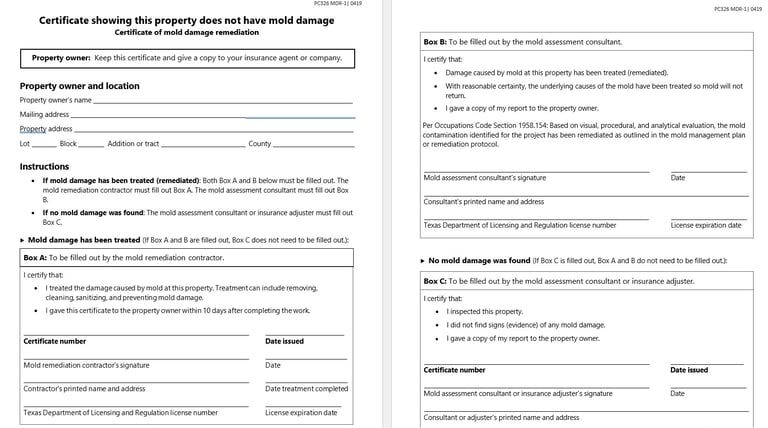
Mold remediation is complete when the mold is gone — right? Not quite, and not under Texas law. In Texas, mold remediation is only legally complete when a licensed Mold Assessment Consultant has returned to the property, performed post-remediation verification testing, confirmed the work meets clearance criteria, and issued a Certificate of Mold Damage Remediation (CMDR).
That certificate is one of the most important documents a Texas homeowner can hold — and most people have never heard of it until they need one urgently.
What Is the Texas CMDR?
The Certificate of Mold Damage Remediation is a legal document issued under Texas Occupations Code Chapter 1958. It certifies that a licensed mold remediation has been performed on a property, that post-remediation verification testing was conducted by an independent licensed MAC, and that the property met clearance criteria at the time of testing.
The CMDR must include:
• The address of the remediated property
• The name and license number of the Mold Assessment Consultant who issued it
• The name and license number of the Mold Remediation Contractor who performed the work
• The date remediation was completed
• The date post-remediation verification testing was performed
• A statement that clearance criteria were met
Texas law requires the CMDR to be issued by an independent MAC — the same separation requirement that applies to the initial assessment. The remediator cannot self-certify their own work as complete.
What Is Post-Remediation Verification Testing?
Post-remediation verification (PRV) — also called clearance testing — is the assessment performed after remediation is complete to confirm that:
• Airborne mold spore counts have returned to normal levels — comparable to outdoor baseline samples
• No visible mold growth remains in the remediated area or adjacent spaces
• Moisture readings in building materials are within acceptable ranges
• The work was performed according to the remediation protocol
PRV testing typically includes air sampling in the remediated area and all adjacent spaces, an outdoor baseline sample for comparison, visual inspection of the remediated area, and moisture readings to confirm the underlying moisture source has been addressed.
If clearance criteria are not met — if spore counts remain elevated or visible growth is found — the remediator must perform additional work before the MAC can issue the CMDR. The process repeats until clearance is achieved.
Why the CMDR Is Valuable Beyond Legal Compliance
Real estate transactions: Texas real estate law requires sellers to disclose known mold damage. A property with a documented, properly remediated mold history — supported by a CMDR — is in a far stronger position than one with an undisclosed or undocumented history. Many real estate agents in The Woodlands and Montgomery County now routinely request CMDRs as part of transaction due diligence. Without one, a buyer's inspector finding evidence of past water damage and mold creates a transaction-threatening uncertainty that a CMDR would resolve immediately.
Insurance claims: When mold damage results from a covered peril — a burst pipe, storm damage, flood — the CMDR is the documentation that closes an insurance claim. It proves the condition was professionally remediated to a legally defined standard. Without it, insurers can reasonably question whether remediation was adequate and complete.
Legal protection: In landlord-tenant disputes, neighbor disputes involving water intrusion, or construction defect claims involving mold, the CMDR is documentary evidence that the property owner took the legally required steps to address the condition. It is the difference between demonstrating responsible action and being unable to prove what was done.
Peace of mind: For families who have experienced mold — particularly those with children, elderly family members, or anyone with respiratory conditions — the CMDR is the professional confirmation that the home is safe to occupy. Not an opinion, not a contractor's word, but a licensed professional's documented finding.
The CMDR and Real Estate in Montgomery County
The Woodlands, Spring, Conroe, and surrounding communities have an active real estate market where buyers increasingly understand the region's mold history. Post-Harvey, the expectation that homes with water damage history carry documentation of professional remediation has become more common, particularly at higher price points.
If you're selling a home in this market that has had any water damage or mold history, a CMDR on file is a transaction asset. It removes the most common source of buyer uncertainty about past damage — and eliminates the negotiating leverage a buyer gains when they find evidence of past water intrusion with no documentation of what was done.
What Happens If Remediation Was Done Without a CMDR
This is one of the most common situations we encounter. A homeowner had mold remediation performed — often in the months following Harvey — but never had clearance testing done and never received a CMDR. The remediation may have been done well, but without the clearance document, it cannot be demonstrated professionally.
In these situations, we can perform a current assessment of the property. While we cannot retroactively certify past remediation work, a current assessment showing normal mold levels and dry building materials provides current documentation of the property's condition. This is not a CMDR — but it is meaningful evidence for real estate and insurance purposes that the home's current condition is acceptable.
Mold Consultant Group and CMDR Issuance
As a TDLR-licensed Mold Assessment Consultant (MAC #1963), Mold Consultant Group is authorized to perform post-remediation verification testing and issue CMDRs in Texas. We have issued CMDRs for residential and commercial properties throughout The Woodlands, Spring, Conroe, Magnolia, Montgomery, and surrounding communities.
If you've recently completed mold remediation and need clearance testing and a CMDR, or if you're selling a property and want documentation of its current mold condition, contact us to schedule an assessment.
Serving Montgomery | The Woodlands | Spring | Conroe | Willis | Tomball | Magnolia | Cypress
📞 Need a Mold Clearance Report or CMDR?
Call 832-280-4747 or schedule an appointment at www.moldconsultantgrp.com
Clear the mold. Clear the air. Protect your investment — with a certified Mold Clearance Report and CMDR from Mold Consultant Group.
This information is provided for educational purposes only. For property-specific recommendations, professional mold testing is recommended.
Have a mold question that isn't covered here? Call 832-280-4747. We're happy to talk through your specific situation — no pressure, no sales pitch. Just honest answers from a licensed professional.
Mold Consultant Group, LLC | PO Box 206, Montgomery, TX 77356 | TDLR Licensed MAC #1963 | IICRC Master Cleaner #266 | Independent — No Remediation Conflict
You Might Also Find Helpful:
→ The Difference Between a Mold Inspector, Assessor & Remediator in Texas
→ The Mold Removal & Remediation Process
https://moldconsultantgrp.com/the-mold-removal-and-remediation-process-what-to-expect
→ Mold Licensing & Certifications in Texas
→ PVR - Post remediation Clearance Testing
Mold Consultant Group
Independent Mold Testing & Iinspection in The Woodlands, TX.
TDLR Licensed MAC #1963.
PO Box 206, Montgomery TX 77356
Company
Hours
Mon–Thu: 9AM–5PM
Friday: 9AM–4PM
Saturday: By Appt
© 2026 Mold Consultant Group, LLC. All rights reserved.
Privacy Policy · Terms of Service · Disclaimer
TDLR MAC #1963 · MRC #0223 · IICRC Master Cleaner #266