TDLR Licensed MAC #1963 · Independent · No Remediation Conflict
Schedule a Free Consultation - Call 832-280-4747
<span>Licensed Mold Testing & Inspection in The Woodlands, TX</span>
Call to Schedule 832-280-4747<a href="tel:8322804747">📞<span>Licensed Mold Testing & Inspection in The Woodlands, TX</span>
<a href="tel:8322804747">📞 832-280-4747 — Free
Mold Remediation process for a Healthy Environment
Discover the essential steps for effective mold remediation and removal. Learn how to restore a healthy environment with our comprehensive guide on mold cleanup.
HOUSTON HOME HEALTH
Brian Boone
4/1/20264 min read
The Mold Removal and Remediation Process: What to Expect
By Mold Consultant Group | TDLR Licensed MAC #1963 | Serving The Woodlands, Spring, Conroe & Montgomery County, TX
If a professional mold assessment has confirmed elevated mold conditions in your home and remediation has been recommended, you may be wondering what happens next. The remediation process — when performed correctly and legally in Texas — follows a defined sequence that protects your home, your family's health, and your legal interests. Here's what to expect at each stage.
One clarification before we begin: Mold Consultant Group does not perform remediation. As a licensed Mold Assessment Consultant (MAC), we assess, write protocols, and perform clearance testing. We describe the remediation process here so you can be an informed consumer when working with licensed Mold Remediation Contractors (MRCs) — and so you know what standards that work should meet.
Stage 1: The Assessment and Written Protocol
Before any remediation work begins, a licensed MAC must perform an assessment and produce a written remediation protocol. This is a legal requirement under Texas TDLR regulations — not optional, not a recommendation.
The written protocol defines:
• The specific areas to be remediated and the extent of material removal required
• The containment measures the MRC must establish before work begins
• The personal protective equipment (PPE) required for workers
• The cleaning and treatment methods to be applied to non-removable surfaces
• The standards that must be met for the work to be considered complete
• The post-remediation verification procedure that will confirm clearance
Do not sign a remediation contract or allow work to begin without a written protocol from an independent licensed MAC. A remediation scope developed by the remediating contractor without an independent assessment is not legally compliant and may significantly overstate or understate what is actually needed.
Stage 2: Containment Setup
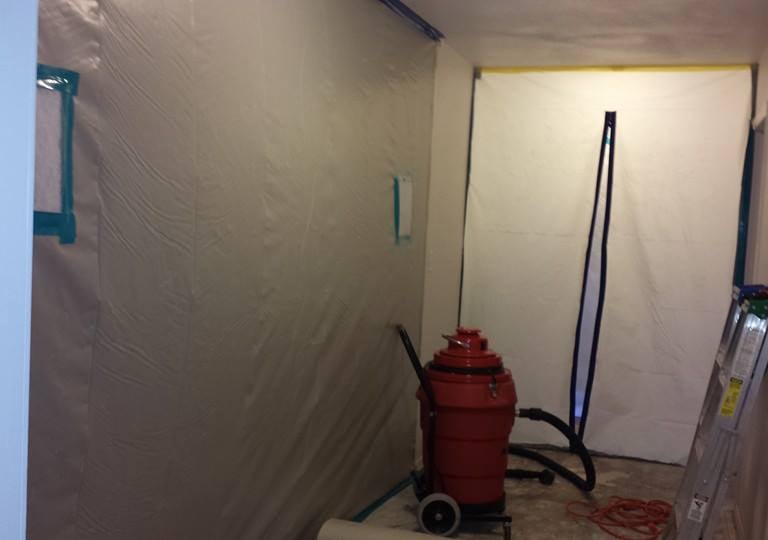
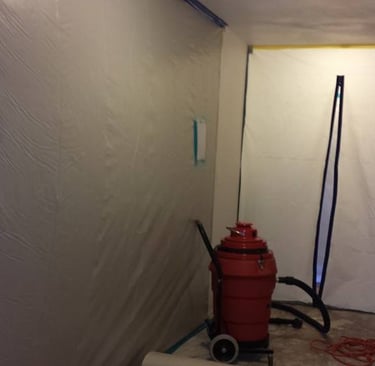
Before any mold-contaminated material is disturbed, the licensed MRC establishes containment — a sealed barrier around the work area designed to prevent mold spores from spreading to unaffected areas of the home during remediation.
Standard containment includes:
• Polyethylene sheeting sealed to walls, floors, and ceilings around the work area
• Negative air pressure within the containment zone — air is exhausted from the contained area to the exterior, preventing spores from migrating outward
• HEPA-filtered air scrubbers that continuously filter the air within the containment zone
• A decontamination chamber at the containment entry point so workers can remove contaminated PPE before exiting
The size and complexity of containment is proportional to the scope of remediation. A small contained area may use simple poly sheeting and a single air scrubber. A large whole-room remediation may use critical barriers and multiple air scrubbers with continuous air changes.
Stage 3: Material Removal
Mold-contaminated porous materials — drywall, insulation, flooring materials, ceiling tiles, and in some cases structural wood — are physically removed within the containment zone. This is the core of professional mold remediation and why surface treatment alone is legally and practically inadequate.
Material removal is performed in a manner that minimizes spore release — wet cutting or misting of materials before removal, double-bagging of waste, and immediate sealing of bags within the containment zone. All removed material is disposed of as regulated waste.
Stage 4: Surface Cleaning and Treatment
After material removal, remaining surfaces within the containment zone — structural framing, concrete, subfloor — are HEPA vacuumed and cleaned. Non-removable surfaces with limited mold contamination may be treated with an EPA-registered antimicrobial. Wire brushing or sanding of mold-affected wood surfaces removes the colonized surface layer before antimicrobial treatment.
Encapsulant products may be applied to treated surfaces as a final step — sealing any residual mold material and providing a moisture-resistant barrier. Encapsulants are used after cleaning as a finishing measure, not as a substitute for proper cleaning.
Stage 5: Post-Remediation Verification (PRV)
After the MRC considers the work complete — but before containment is removed and reconstruction begins — an independent licensed MAC performs post-remediation verification testing. This is the clearance test that confirms the remediation was successful.
PRV testing includes:
• Air sampling within the remediated area and all adjacent spaces
• An outdoor baseline sample for comparison
• Visual inspection of all remediated surfaces for any remaining visible growth
• Moisture readings confirming building materials are at acceptable dry levels
If clearance criteria are met — indoor spore counts comparable to outdoor baseline, no visible growth, dry building materials — the MAC issues a Certificate of Mold Damage Remediation (CMDR). If criteria are not met, the MRC performs additional work and the process repeats.
Stage 6: Reconstruction
After a successful PRV and CMDR issuance, reconstruction can begin — replacing drywall, insulation, flooring, and finishes removed during remediation. Reconstruction is typically performed by a general contractor or the homeowner's preferred repair contractor, separate from the MRC.
One critical point: reconstruction should not begin until the MAC has confirmed dry building materials in the PRV. Enclosing new drywall over structural members that haven't fully dried restarts the moisture-mold cycle in a newly renovated space.
What You Should Receive at the End of the Process
Documentation package from a complete, legally compliant remediation:
Pre-remediation assessment report from the independent MAC
Written remediation protocol signed by the MAC
Remediation contractor's completion documentation and invoices
Post-remediation verification test results
Certificate of Mold Damage Remediation (CMDR) issued by the independent MAC
All laboratory reports from both pre- and post-remediation air sampling
Keep this documentation permanently. It is your proof that the work was performed to a legally defined standard — valuable for insurance claims, real estate transactions, and your own peace of mind.
Need an assessment before remediation, or clearance testing after? Call 832-280-4747. We write protocols and issue CMDRs throughout The Woodlands, Spring, Conroe, and all of Montgomery County.
Mold Consultant Group, LLC | PO Box 206, Montgomery, TX 77356 | TDLR Licensed MAC #1963 | IICRC Master Cleaner #266 | Independent — No Remediation Conflict
Serving Montgomery | The Woodlands | Spring | Conroe | Willis | Tomball | Magnolia | Cypress
Ready to Start the Mold Remediation Process?
Call 832-280-4747 or schedule your consultation at www.moldconsultantgrp.com
From discovery to documentation — we’re your trusted guide through every step of safe, certified mold remediation.
This information is provided for educational purposes only. For property-specific recommendations, professional mold testing is recommended.
You Might Also Find Helpful:
→ Mold Clearance Reports and the Texas CMDR
https://moldconsultantgrp.com/mold-clearance-reports-and-the-texas-cmdr
→ The Difference Between a Mold Inspector, Assessor & Remediator in Texas
→ Learn Why Mold — Alive or Dead — Can Harm Your Health
https://moldconsultantgrp.com/learn-why-mold-alive-or-dead-can-harm-your-health
Mold Consultant Group
Independent Mold Testing & Iinspection in The Woodlands, TX.
TDLR Licensed MAC #1963.
PO Box 206, Montgomery TX 77356
Company
Hours
Mon–Thu: 9AM–5PM
Friday: 9AM–4PM
Saturday: By Appt
© 2026 Mold Consultant Group, LLC. All rights reserved.
Privacy Policy · Terms of Service · Disclaimer
TDLR MAC #1963 · MRC #0223 · IICRC Master Cleaner #266