TDLR Licensed MAC #1963 · Independent · No Remediation Conflict
Schedule a Free Consultation - Call 832-280-4747
<span>Licensed Mold Testing & Inspection in The Woodlands, TX</span>
Call to Schedule 832-280-4747<a href="tel:8322804747">📞<span>Licensed Mold Testing & Inspection in The Woodlands, TX</span>
<a href="tel:8322804747">📞 832-280-4747 — Free

Why Moisture Mapping & Infrared Imaging Are Game-Changers in Mold Detection
Think mold only shows up when you can see it? Think again. Hidden mold growth can be common—and costly—issues in properties. Moisture mapping and Mold detection are useful tools to identify potential problem areas.
MOLD ASSESSMENT & TESTING
Brian Boone
4/15/20264 min read
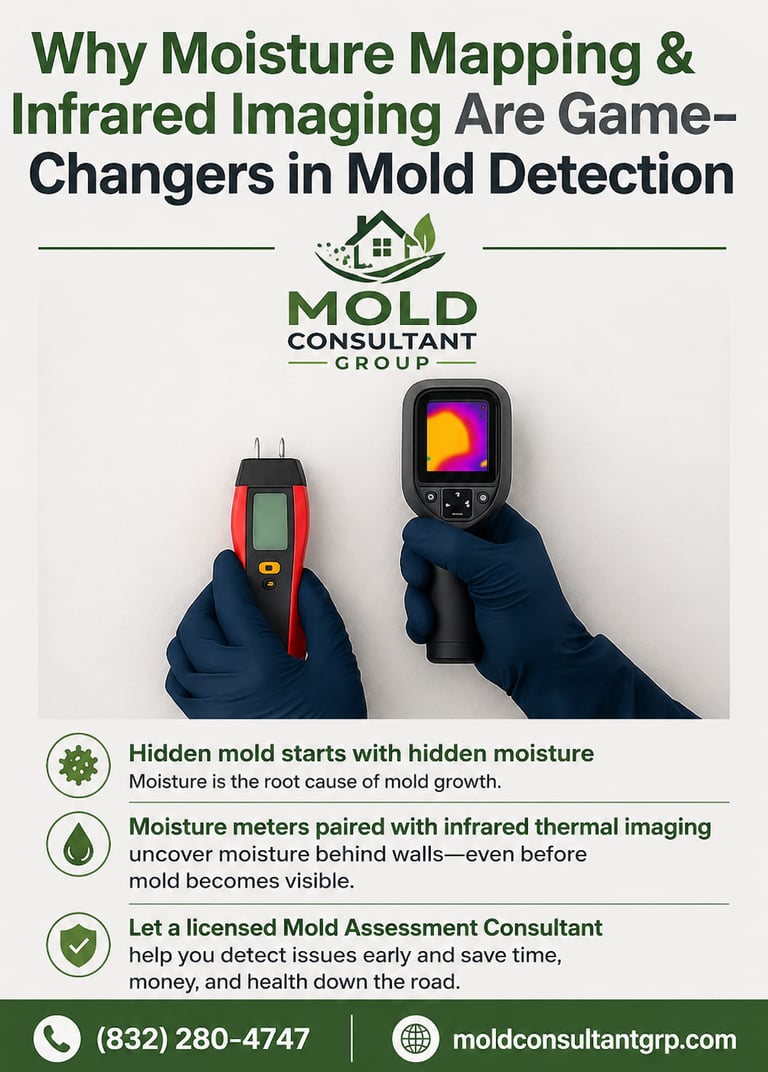
Why Moisture Mapping and Infrared Imaging Are Game-Changers in Mold Detection
By Mold Consultant Group | TDLR Licensed MAC #1963 | Serving The Woodlands, Spring, Conroe & Montgomery County, TX
A generation ago, finding mold inside a wall meant cutting it open. Assessment was invasive, expensive, and often missed the full extent of contamination because you could only investigate where you chose to cut. The combination of calibrated moisture meters and infrared thermal imaging cameras changed that — giving licensed mold assessors the ability to see through walls, identify moisture-affected zones non-invasively, and target sampling to the locations most likely to reveal hidden problems.
For homeowners in The Woodlands, Spring, Conroe, and Montgomery County dealing with a region that delivers moisture challenges from multiple directions simultaneously, these tools represent a significant advance in what professional mold assessment can find and how confidently it can define the boundaries of a problem.
t
This information is provided for educational purposes only. For property-specific recommendations, professional mold testing is recommended.
The Problem These Tools Solve
Traditional visual mold assessment has a fundamental limitation: you can only see the surface. Mold that is actively growing inside a wall cavity, under a hardwood floor, or in an attic space between insulation batts is invisible to visual inspection until it has spread enough to reach a visible surface — which typically takes weeks or months of growth, during which the condition is worsening and the remediation scope is expanding.
The same limitation applies to moisture: a wall assembly that is wet on the inside but dry on the outside surface gives no visual indication of its condition. By the time water staining or paint bubbling appears on the painted surface, the drywall paper behind it has been wet long enough for mold to establish — and the moisture may have spread laterally well beyond the visible staining area.
Moisture mapping and infrared imaging directly address this limitation by giving the assessor information about conditions behind the surface — without cutting open the wall.
How Infrared Thermal Imaging Works in Practice
An infrared camera detects the heat emitted by building surfaces and represents those temperatures as a color-coded image — typically blue and purple for cooler areas, yellow and red for warmer areas. When a wall cavity contains moisture, the wet material has different thermal mass than dry material. It heats and cools at a different rate, creating a temperature differential visible on the camera.
In practice, an experienced assessor scans wall and ceiling surfaces with the IR camera, looking for thermal anomalies — areas where the temperature pattern is inconsistent with the surrounding material. A cold spot on an interior wall that has no adjacent plumbing or HVAC component is a strong indicator of moisture infiltration. A warm band running horizontally along a wall often indicates the height to which water wicked upward after a flood event.
These anomalies guide subsequent investigation — directing moisture meter readings and, when warranted, targeted invasive inspection to the specific locations the thermal imaging identified. This dramatically reduces both the cost of investigation (fewer unnecessary cuts) and the risk of missing significant moisture conditions (targeted investigation of flagged areas).
Real-World Applications in Our Market
Post-Harvey assessments: Following Hurricane Harvey, we used infrared imaging extensively to map the height of moisture wicking in flooded walls — identifying that water had wicked 18 to 24 inches above the visible water line in many homes, defining a larger remediation scope than visual inspection alone would have suggested and ensuring complete material removal.
New construction verification: In newly built homes in The Woodlands and Magnolia corridors, thermal imaging has identified moisture trapped in wall assemblies during construction — wet framing lumber enclosed before it dried, producing thermal signatures at specific stud bays that directed targeted moisture meter investigation.
Slab moisture migration: Infrared imaging of lower wall assemblies in homes with slab foundations frequently reveals a band of cooler temperature at the base of exterior walls — the signature of ground moisture migrating upward through the concrete and into wall assembly materials. This chronic condition is invisible to visual inspection and easy to mistake for normal variation in thermal imaging without experience in this specific pattern.
HVAC condensation mapping: Thermal imaging around supply registers, air handler cabinets, and ductwork reveals condensation patterns that indicate either HVAC performance issues or building envelope failures at those locations — identifying the moisture source rather than just documenting its effects.
The Combination That Matters
Neither moisture mapping nor infrared imaging works in isolation as well as they do together. Infrared imaging rapidly identifies zones of suspected moisture across large areas. Moisture meters then provide precise, quantified readings at those specific locations — confirming whether the thermal anomaly represents actual elevated moisture content or a thermal effect from insulation variation, HVAC airflow, or other non-moisture causes.
This combination — thermal imaging for area scanning, moisture meters for confirmation and quantification — is what allows a professional assessment to define moisture boundaries with precision rather than approximation. That precision directly reduces remediation cost: contractors remove what the moisture map shows is affected, not a larger area chosen to ensure they got everything.
What This Means for You as a Homeowner
When you schedule a professional mold assessment with Mold Consultant Group, infrared thermal imaging and moisture mapping are part of the toolkit we bring to your home — not an optional add-on. The assessment findings you receive reflect not just what's visible on surfaces but what the combination of thermal imaging, moisture meters, and air sampling reveals about conditions behind those surfaces.
This level of assessment is the difference between knowing you have a mold problem and understanding its full extent, its moisture source, and what it will take to resolve it properly.
Call 832-280-4747 to schedule a comprehensive mold assessment including infrared thermal imaging and moisture mapping. Serving The Woodlands, Conroe, Spring, Montgomery, and all surrounding communities.
Mold Consultant Group, LLC | PO Box 206, Montgomery, TX 77356 | TDLR Licensed MAC #1963 | IICRC Master Cleaner #266 | Independent — No Remediation Conflic
Don’t wait until mold is visible or causes health issues. If you’ve had water damage, suspect moisture problems, or simply want peace of mind—call Mold Consultant Group today.
📞 832-280-4747
🌐 www.moldconsultantgrp.com
🛠 Serving The Woodlands, Conroe, Cypress, Spring, Magnolia, Tomball, Willis, Montgomery, and surrounding areas.
You Might Also Find Helpful:
→ The Role of Moisture Mapping in Mold Inspections
https://moldconsultantgrp.com/the-role-of-moisture-mapping-in-mold-inspections
→ Mold and UV/Infrared Lights
https://moldconsultantgrp.com/mold-and-ultraviolet-uv-lights-and-infrared-ir-lights
→ How Mold Affects Your HVAC System
Mold Consultant Group
Independent Mold Testing & Iinspection in The Woodlands, TX.
TDLR Licensed MAC #1963.
PO Box 206, Montgomery TX 77356
Company
Hours
Mon–Thu: 9AM–5PM
Friday: 9AM–4PM
Saturday: By Appt
© 2026 Mold Consultant Group, LLC. All rights reserved.
Privacy Policy · Terms of Service · Disclaimer
TDLR MAC #1963 · MRC #0223 · IICRC Master Cleaner #266