TDLR Licensed MAC #1963 · Independent · No Remediation Conflict
Schedule a Free Consultation - Call 832-280-4747
<span>Licensed Mold Testing & Inspection in The Woodlands, TX</span>
Call to Schedule 832-280-4747<a href="tel:8322804747">📞<span>Licensed Mold Testing & Inspection in The Woodlands, TX</span>
<a href="tel:8322804747">📞 832-280-4747 — Free
Moisture Mapping in Mold Inspections: Key Insights
Discover the crucial role of moisture mapping in mold inspections. Understand how moisture levels contribute to mold growth and learn about effective strategies to prevent water damage in your property.
MOLD ASSESSMENT & TESTING
Brian Boone
5/17/20264 min read
Moisture Mapping in Mold Inspections: What It Is and Why It Matters
One of the most common misconceptions about mold inspections is that they're primarily about finding mold that's already visible. In reality, the most valuable part of a professional mold assessment is often what happens before any samples are collected: a systematic moisture survey of the property that maps hidden water intrusion before it becomes a visible mold problem.
Moisture mapping is a core component of how Mold Consultant Group approaches every assessment. Here's what it involves, the tools used, and why it provides insights that visual inspection alone cannot.
Why Moisture Is the Real Target
Mold cannot grow without a moisture source. Find and eliminate the moisture, and you interrupt the mold growth cycle at its root. This is why a mold assessment focused only on air sampling and visible surfaces — without systematic moisture investigation — misses half the picture. An assessor who can tell you that your spore counts are elevated but cannot identify where the moisture is coming from has left you with a diagnosis but no address.
Moisture mapping solves this by creating a documented record of moisture readings across the surfaces of a property — walls, floors, ceilings, around windows, near plumbing penetrations — that reveals the pattern and likely source of water intrusion even when there's no visible staining, no obvious leak, and no currently active water event.
Tools Used in Moisture Mapping
Professional moisture assessments use several complementary instruments:
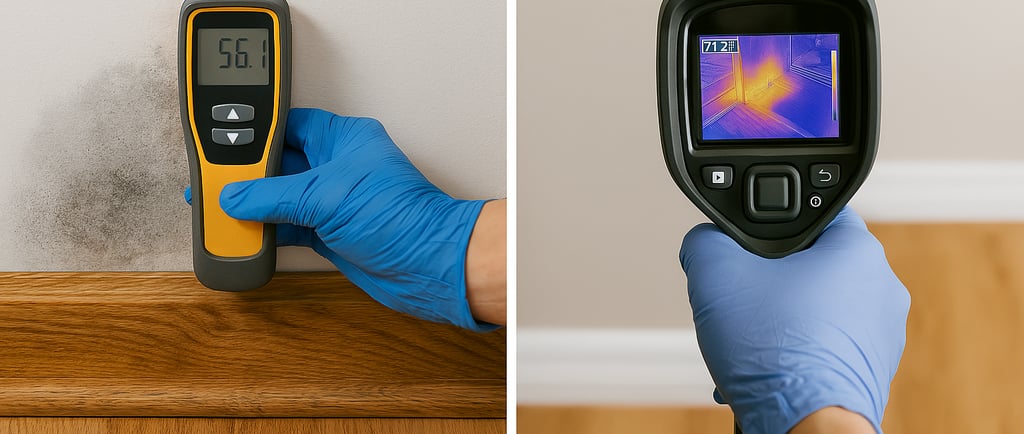
• Pin-type moisture meters — These meters drive two small pins into a surface and measure electrical resistance, which correlates with moisture content. They're highly accurate for wood, drywall, and other building materials and are the primary tool for getting readings at specific points. A reading above the material's equilibrium moisture content indicates abnormal moisture presence.
• Pinless (non-invasive) moisture meters — These use radio frequency or electromagnetic signals to detect moisture beneath a surface without penetrating it. They're used for scanning large areas quickly to identify zones that warrant more detailed investigation, and for materials like tile or finished flooring where pin insertion isn't appropriate.
• Thermal imaging (infrared) cameras — Infrared cameras detect surface temperature variation. Wet areas cool differently from dry areas as moisture evaporates, creating a thermal signature that appears as a distinct cool zone on the camera display. Thermal imaging is particularly valuable for identifying moisture patterns inside wall cavities and ceiling assemblies without destructive testing, and for visualizing the full extent of a moisture intrusion zone that might be far larger than any visible staining suggests.
What Moisture Mapping Reveals
A systematic moisture survey creates a documented map of the property showing where moisture readings exceed normal thresholds. This reveals several things that other testing cannot:
• The origin point of water intrusion — whether it's a roof penetration, plumbing leak, window seal failure, or ground-level moisture migration.
• The migration path — water does not stay where it enters. It travels along framing, wicks through insulation, and accumulates in low points. Moisture mapping traces this path.
• The full extent of affected materials — a visible stain on a wall may be the surface expression of a moisture zone that spans several feet of wall cavity in every direction. Knowing the actual extent drives accurate remediation scoping.
• Dry pockets within a wet zone — documenting which materials have dried and which remain wet is essential for both remediation planning and clearance assessment.
Moisture Mapping and Remediation Scoping
The documented moisture map becomes part of the written remediation protocol that the mold assessment consultant provides to the remediation contractor. It defines the boundaries of the work area based on where moisture and potential mold colonization actually exist — not just where it's visible. This protects homeowners from both under-remediation (leaving contaminated materials in place) and over-remediation (removing materials that don't need to be removed).
Moisture Mapping After Remediation
Post-remediation clearance assessments also include moisture verification. Before clearance can be granted, the assessor confirms that the moisture conditions that supported mold growth have been corrected. Clearance with elevated moisture readings still present is not meaningful — it only confirms the current state, not the long-term outcome.
If you're concerned about water intrusion or potential mold in your home or commercial property, moisture mapping as part of a full independent assessment is the right first step. Mold Consultant Group provides comprehensive moisture surveys and mold assessments throughout The Woodlands, Spring, Conroe, and Montgomery County. Call 832-280-4747 or visit moldconsultantgrp.com.
Montgomery | The Woodlands | Spring | Conroe | Willis | Tomball | Magnolia | Cypress
Need a Mold Inspection That Goes Beyond the Surface?
Call 832-280-4747
You can’t fix what you can’t see — that’s why we map the moisture before the mold.
This information is provided for educational purposes only. For property-specific recommendations, professional mold testing is recommended.
You Might Also Find Helpful:
→ Why Moisture Mapping & Infrared Imaging Are Game-Changers
→ Mold and UV/Infrared Lights
https://moldconsultantgrp.com/mold-and-ultraviolet-uv-lights-and-infrared-ir-lights
→ Why DIY Mold Testing Kits Fall Short
https://moldconsultantgrp.com/why-diy-mold-home-testing-kits-fall-short
Mold Consultant Group
Independent Mold Testing & Iinspection in The Woodlands, TX.
TDLR Licensed MAC #1963.
PO Box 206, Montgomery TX 77356
Company
Hours
Mon–Thu: 9AM–5PM
Friday: 9AM–4PM
Saturday: By Appt
© 2026 Mold Consultant Group, LLC. All rights reserved.
Privacy Policy · Terms of Service · Disclaimer
TDLR MAC #1963 · MRC #0223 · IICRC Master Cleaner #266