TDLR Licensed MAC #1963 · Independent · No Remediation Conflict
Schedule a Free Consultation - Call 832-280-4747
<span>Licensed Mold Testing & Inspection in The Woodlands, TX</span>
Call to Schedule 832-280-4747<a href="tel:8322804747">📞<span>Licensed Mold Testing & Inspection in The Woodlands, TX</span>
<a href="tel:8322804747">📞 832-280-4747 — Free
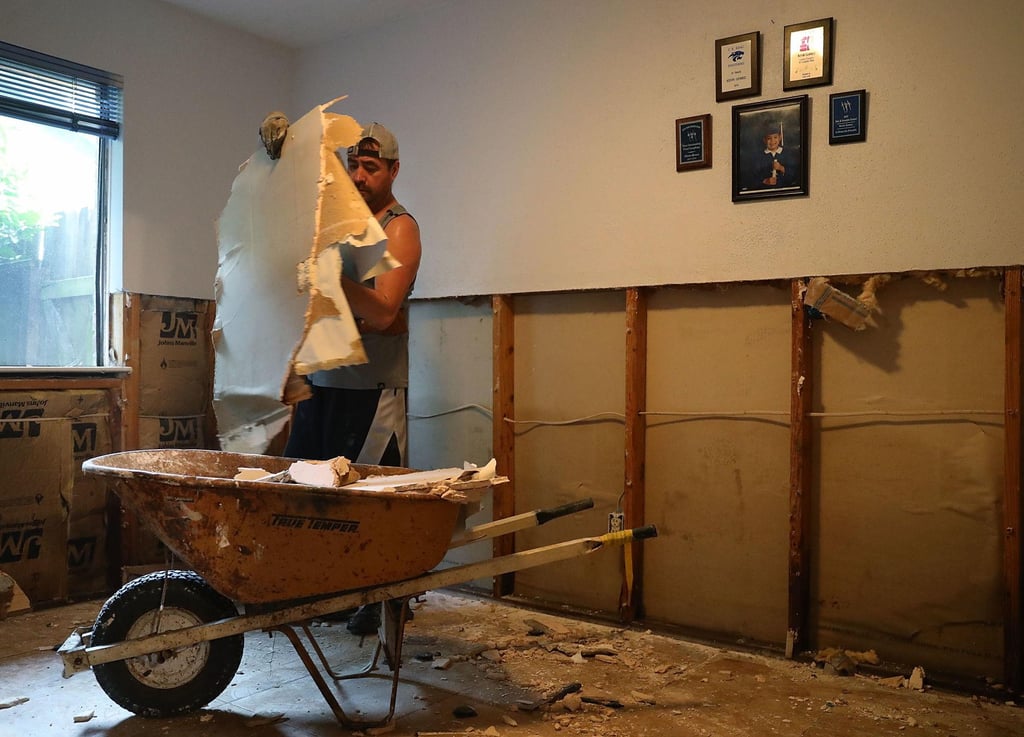
Flooded and “Fixed” - Improper Incomplete Flood Remediation
Harvey flooded 154,000 Houston homes. Many were “repaired” — but improper incomplete flood remediation leaves hidden mold, asbestos, and structural damage. What 1970s and 1980s homes need that most flood repairs never address.
FLOOD AND WATER DAMAGE
Brian Boone
6/11/202612 min read
Flooded and “Fixed”
Harvey flooded 154,000 Houston homes. Many were “repaired” — but incomplete remediation leaves hidden mold, asbestos, and structural damage. What 1970s and 1980s homes need that most flood repairs never address.
Houston floods. This is not a new observation — it is a defining fact of life for hundreds of thousands of homeowners across Harris, Montgomery, Fort Bend, and Galveston counties. Hurricane Harvey delivered an estimated 60 inches of rain over four days in August 2017, flooding approximately 154,000 homes across the metro. Before Harvey, there was Tax Day 2016. Before that, Memorial Day 2015. Allison in 2001.
What happens after the water recedes matters as much as the flood itself. And in the greater Houston area, the story of what happens after is deeply complicated by the age of the housing stock, the specific construction materials used in homes built in the 1970s and 1980s, the economics of post-disaster repair, and a recurring pattern of remediation that looks complete but isn't.
This post is specifically for homeowners and buyers of homes built in the 1970s and 1980s in the Houston metro area — and for the real estate professionals, insurance adjusters, and attorneys who work with those properties.
The 72-Hour Window Nobody Respects
The single most important fact about flood-related mold is one that most homeowners learn too late: in Houston's heat and humidity, mold growth begins within 2 48 to 72 hours of water intrusion.
This is a function of the specific environmental conditions of the Houston metro — ambient temperatures that rarely drop below 70°F, year-round relative humidity averaging 65–75%, and building materials that absorb and hold water aggressively. Homeowners who extracted water and began professional drying within 24–48 hours experienced significantly less mold contamination than those who waited even a few days.
After Hurricane Harvey, many Houston homes that were not professionally dried within the first 48–72 hours developed significant mold contamination within two weeks. Two weeks. In a home still being assessed for insurance and waiting for contractors to begin work.
⛑ The 72-hour window is the most important concept in post-flood mold prevention. After it closes, the question shifts from prevention to remediation.


Why 1970s and 1980s Houston Homes Are a Different Problem
The Houston-area homes that experienced the most severe flood impacts during Harvey were concentrated in neighborhoods dominated by older housing stock — Meyerland, Kingwood, Clear Lake, the Heights, Montrose, Garden Oaks, Oak Forest, Bellaire, and established suburbs throughout Harris and Montgomery counties. These neighborhoods were built primarily between the late 1950s and mid-1980s, using materials and construction practices fundamentally different from modern standards.
Asbestos was commonly used in home construction through the late 1980s, with peak usage between the 1950s and 1970s. In a typical Houston home built between 1960 and 1985, asbestos-containing materials may be present in:
• 9”×9” and 12”×12” vinyl floor tiles and the mastic adhesive beneath vinyl sheet flooring
• Acoustic drop ceiling tiles in dens, garages, and utility rooms
• Spray-on popcorn / textured ceiling finish — widely applied through the 1970s and into the 1980s
• Pipe and duct wrap insulation on hot water pipes and HVAC duct joints
• Drywall joint compound — asbestos used as a strengthening agent in some products through the early 1970s
• Exterior cement asbestos board siding and asbestos-cement roof shingles
When these materials are intact and undisturbed, they pose minimal risk. When flooding saturates and damages them — and a contractor arrives to tear them out without prior testing — asbestos fibers are released into the air of a home with vulnerable occupants. Natural disasters such as floods can cause asbestos-containing materials to release toxic fibers. Breathing these fibers can lead to serious health conditions years later.
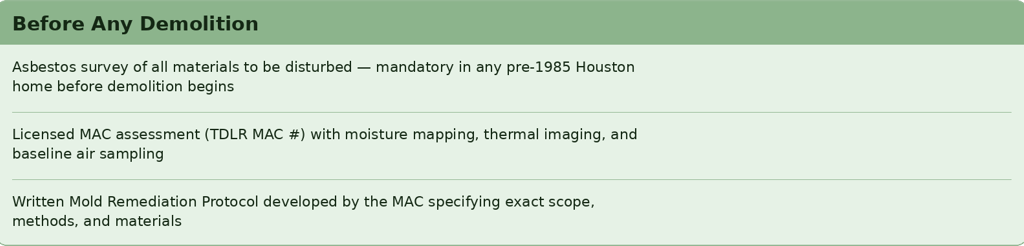
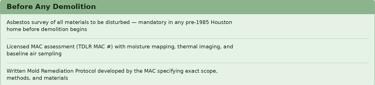
⛑ No proper flood remediation of a pre-1985 Houston home should proceed without an asbestos survey of materials to be disturbed. This must happen before demolition begins.


Homes built in the 1970s may contain UFFI — a product injected into wall cavities as an alternative to fiberglass.
The U.S. Consumer Products Safety Commission raised concerns about UFFI due to formaldehyde emissions as it ages. When UFFI becomes saturated with floodwater, it degrades rapidly, cannot be dried, and must be removed. Its removal releases formaldehyde gas into the interior. Post-flood remediation that opens walls with UFFI without proper ventilation and occupant protection creates an acute formaldehyde exposure event.
Composite wood paneling bonded with formaldehyde-based resins and particleboard subflooring
Both common in 1970s and early 1980s construction — absorb water aggressively, swell, delaminate, and develop mold within 24–48 hours of saturation. They also off-gas formaldehyde during and after wetting as the binders break down. Post-flood work that attempts to dry these materials in place is not remediation — it is delay. Saturated particleboard that has swollen must be removed, not dried.
Pier-and-beam foundations were the dominant construction method in Houston's established neighborhoods
Tthe Heights, Montrose, Midtown, Garden Oaks, Eastwood, Riverside Terrace — prior to the 1970s when slab foundations took over. Unlike slab-on-grade homes, pier-and-beam construction has an entire layer beneath the living area where mold can grow completely unseen.
Hurricane Harvey and subsequent flooding events left sub-floor moisture in thousands of Houston pier-and-beam homes. Even homes that appeared dry above the floor line frequently retained water in the crawl space long enough to establish mold colonies. Many that appeared to recover after Harvey retained sub-floor moisture that established mold colonies within 72 hours — and those colonies have persisted.
The critical failure in post-flood remediation of pier-and-beam homes: addressing only what is visible above the floor. A remediation that strips drywall, cleans wall cavities, and replaces flooring but never inspects the crawl space has addressed perhaps half the contamination. The other half will wick moisture upward through the subfloor continuously, driving mold growth back into walls and floors within months.
⛑ Pier-and-beam crawl space inspection is non-negotiable in any flood assessment of older Houston homes. It is the most commonly skipped step and the most reliable source of recurrence.








A Hidden Failure Nobody Talks About: Tar Paper, Exterior Gypsum Sheathing, and the Drainage Plane
There is a specific category of post-flood repair error that is widespread in the Houston market, creates a concealed and ongoing moisture problem, and is almost never identified until the damage has been done for years. It involves a material most homeowners have never thought about: the exterior gypsum sheathing board behind the brick veneer of their home.
Understanding this issue requires a brief look at how a typical Houston-area brick veneer wall is actually built — and what happens to it when it floods.
How a Brick Veneer Wall Assembly Works
In the vast majority of Houston-area homes, the brick you see on the exterior is not a structural wall. It is a veneer — a single layer of brick approximately 3.5 inches thick, anchored to the structural wood-framed wall behind it with metal ties but not bearing any structural load. Between the brick veneer and the wood-framed wall is a narrow air gap — typically 1 inch — that serves a critical drainage function.
Behind that air gap, attached to the exterior face of the wood studs, is the wall’s sheathing layer. In homes built from the 1980s onward, this sheathing is frequently exterior-grade gypsum board — a product manufactured specifically for exterior applications and rated for moisture exposure. Over that gypsum sheathing, running continuously from top plate to sill plate and lapped at seams, is a layer of No. 15 asphalt felt paper — commonly called tar paper — or a modern housewrap equivalent.
Together, the gypsum sheathing, the tar paper or housewrap, and the air gap behind the brick form what building science calls the drainage plane — a continuous, uninterrupted barrier that sheds water outward and directs any moisture that penetrates the brick veneer down through the air cavity and out through weep holes at the base of the wall.
⛑ Texas Building Code (IBC 2021 Section 1404.2) requires not fewer than one layer of water-resistive barrier material attached in such a manner as to provide a continuous water-resistive barrier behind the exterior wall veneer. The word “continuous” is the operative requirement.
What Flooding Does to This Assembly
When floodwater enters a Houston home, it saturates the wall assembly from the interior. The interior drywall, insulation, and framing absorb water rapidly. What is less visible — and what most flood contractors never check — is what happens on the exterior side of the wall framing.
Exterior gypsum sheathing, despite being rated for exterior use, is still a gypsum-core product. Extended saturation during a flood event — particularly when water infiltrates the weep holes at the base of the brick veneer and rises inside the brick cavity — will saturate the exterior gypsum board from the outside in. The tar paper or housewrap layer may slow this process but rarely prevents it entirely during a significant flood event.
Once saturated, exterior gypsum sheathing becomes a prime substrate for mold growth. Because it sits on the exterior face of the framing, hidden behind brick veneer that cannot be removed without demolition, this mold is completely invisible during any standard post-flood inspection. It will not be found by a visual inspection. It will not register on a moisture meter probing from the interior. It exists in a concealed cavity that most contractors never access.
The Stud-Bay Cut Error: The Most Common — and Most Damaging — Repair Mistake
After a flood, when a homeowner or contractor recognizes that the exterior gypsum sheathing has been damaged or contaminated, the instinct is to repair it as efficiently as possible. The approach that most post-flood contractors use — and that is fundamentally incorrect — is to cut out and replace the exterior gypsum board in sections between the studs.
The logic seems straightforward: open the wall cavity from the interior, cut out the damaged section of exterior sheathing between two studs, slide in a new piece, and close the wall back up. It’s faster, cheaper, and avoids the cost and disruption of removing the brick veneer.
The problem is that this approach permanently compromises the drainage plane — and creates a moisture pathway into the wall assembly that will generate mold for the remaining life of the home.
This problem is such an important topic, that it will have it's own blog in the next few weeks. Check back Often
How Incomplete Flood Remediation Happens: The Real-World Pattern
The Insurance and FEMA Repair Economy
After Harvey, the Texas General Land Office administered the PREPS program — federally funded temporary repairs up to $20,000 for flood-damaged homes. Community groups and affected homeowners documented numerous cases of contractors ignoring mold that had grown in walls and cabinets, with mold subsequently growing on new insulation and drywall installed over unaddressed contamination. One documented case involved a homeowner who reported that contractors ignored mold in walls and cabinets; the mold grew on new materials that then had to be discarded.
The economics of disaster repair create conditions where speed is incentivized and thoroughness is not. Insurance adjusters process thousands of claims simultaneously. Contractors are booked weeks out. Homeowners are displaced and desperate to return. In this environment, shortcuts are not aberrations — they are the norm.
The Visible-Surface Trap
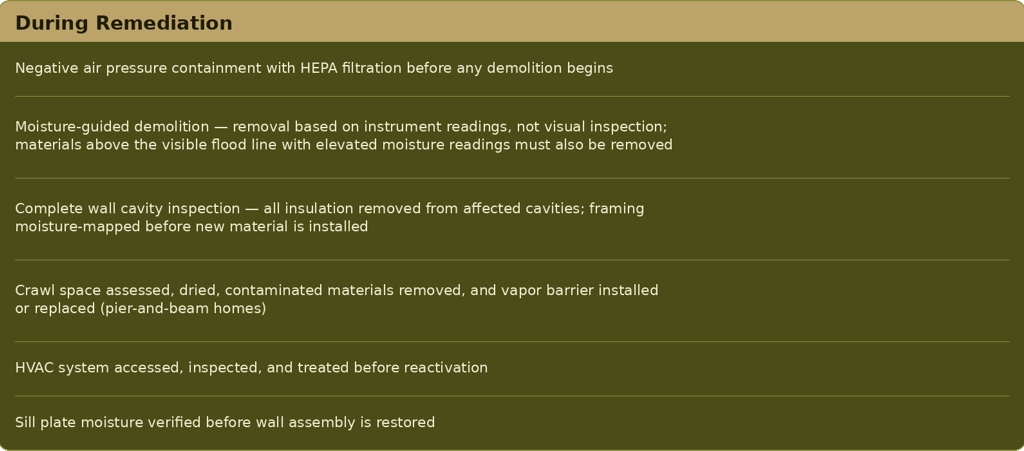
The most common form of incomplete remediation addresses only what is visible to the naked eye: strip wet drywall to the flood line, remove saturated flooring, spray visible mold with biocide, install new drywall and flooring.
What this work misses:
• Wall cavities above the flood line — water travels upward through capillary action; insulation holds moisture against framing for weeks above the visible water line
• HVAC systems and ductwork — in Houston, where HVAC runs year-round, untreated ducts become the highway for mold distribution to every room in the house
• Crawl spaces in pier-and-beam homes — as described above, a fundamentally incomplete remediation if ignored
• The subfloor assembly — floodwater migrates under flooring; mold grows in this hidden zone within 48 hours
• Sill plates — the lowest horizontal framing member saturates first and in older homes is often original untreated lumber that becomes a persistent moisture and mold source
The Moisture Verification Failure
Perhaps the most consequential technical failure: declaring a structure dry based on surface appearance rather than instrument verification. Drywall that feels dry to the touch can contain elevated moisture levels behind the paper face. Framing studs that appear dry may have moisture pockets at their core — particularly true in the dense, slow-drying old-growth lumber used in pre-1970s construction.
Professional moisture verification requires calibrated meters measuring actual material moisture content at multiple depths — surface, mid-depth, and core. A single surface reading on the day work is completed is a snapshot, not verification. Residual moisture redistributes within building assemblies over the following 48–72 hours.
What Gets Left Behind: Health Consequences
Mold Species Common to Houston Flood Events
Post-flood colonization in the Houston climate typically involves a characteristic mixture:
• Cladosporium and Aspergillus/Penicillium — initial colonizers on wet drywall, ceiling tiles, and dust-laden surfaces; allergenic, exacerbate respiratory conditions
• Stachybotrys chartarum (black mold) — requires sustained moisture; found in hidden areas where moisture was not fully addressed; associated with mycotoxin production
• Chaetomium — marker species in paper-faced drywall and cellulose materials; its presence in post-remediation samples is a reliable indicator of remaining contamination
• Trichoderma and Ulocladium — common in post-flood wall cavities and wet wood framing
⛑ The presence of Stachybotrys or Chaetomium in post-remediation air samples is a definitive indicator that physical source removal was incomplete.
The Crawl Space Stack Effect
For pier-and-beam homeowners, incomplete crawl space remediation creates an ongoing exposure pathway that continues indefinitely. Through the stack effect — warm air rising through the building — air from a mold-contaminated crawl space continuously enters the living area above. This is a continuous source of spore introduction day after day, regardless of how well above-floor work was performed.
Structural Consequences
Beyond air quality, incomplete remediation carries structural consequences that compound over time. Saturated sill plates rot. Framing with persistent moisture develops decay fungi that compromise load-bearing capacity. In pier-and-beam homes, wet wood piers and beams eventually fail — manifesting as uneven floors, sticking doors, and visible settling years after the triggering flood event.
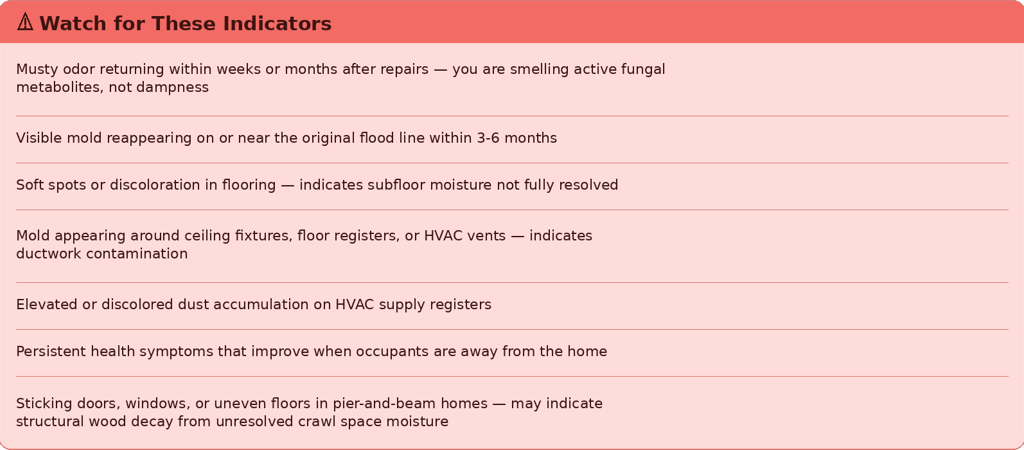
Warning Signs of Incomplete or Improper Flood Remediation
What Proper Post-Flood Assessment and Remediation Looks Like
For Buyers of Flood-History Houston Homes
The Texas Seller's Disclosure Notice requires sellers to disclose known flooding, water damage, and previous mold remediation. But disclosure of a prior remediation does not disclose whether that remediation was adequate. A seller who had flood work done and honestly discloses it may have no idea the work was incomplete.
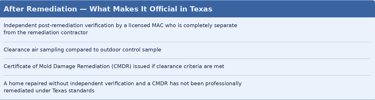
Before purchasing any Houston-area home with a known flood history — particularly any home built before 1985 — a pre-purchase mold assessment by an independent, licensed MAC should be considered non-negotiable. This assessment should include air sampling in multiple locations including the crawl space, surface sampling of any stained or odorous areas, moisture mapping of all previously affected areas, and review of any available remediation documentation including the CMDR.
Where Mold Consultant Group Fits In
Mold Consultant Group provides the independent, licensed assessment that is both the starting point of any proper remediation — and the verification of whether a prior remediation actually achieved what it claimed to.
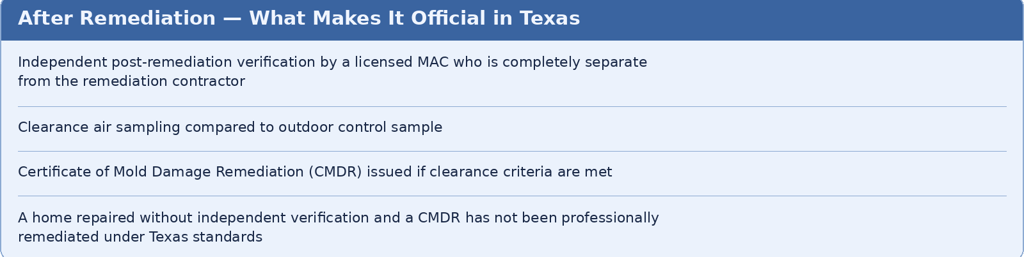
We are TDLR Licensed MAC #1963. We assess properties before remediation to establish scope and write the protocol. We return after remediation to verify the work and issue the CMDR if clearance is met. We work with homeowners, buyers, sellers, real estate agents, insurance claimants, and attorneys throughout The Woodlands, Conroe, Spring, Tomball, Magnolia, Willis, Cypress, and the greater Houston metro.
We don't perform remediation. We don't refer clients to contractors we have financial arrangements with. Our assessment reflects exactly what we find.
This information is provided for educational purposes only. For property-specific recommendations, professional mold testing is recommended.
You Might Also Like
More from Mold Consultant Group — resources on flood mold, IAQ hazards, and Texas remediation law.
Indoor Air Quality Dangers During Home Repairs & Renovation
Silica dust, fiberglass, VOC off-gassing, lead dust — the full picture of what gets released into your air during repair work. Essential reading before any flood repair begins in a pre-1985 home.
Mold Air Treatments Compared: AFDs, Ozone, CLO2, Fogging & Pairing Agents
What every air treatment method does and doesn't do — the framework for evaluating any remediation proposal involving fogging, fumigation, or air filtration.
The Paston Effect — Attic Mold in Hot Humid Climates
Post-flood HVAC and roofing repairs frequently trigger the Paston Effect in two-story homes near Lake Conroe and The Woodlands. Understanding the mechanism helps prevent it.
How to Read Your Mold Lab Report
After post-flood remediation, clearance testing produces a lab report. This plain-English guide explains every section so you know whether your home actually passed.
Mold Clearance Reports and the Texas CMDR
The Certificate of Mold Damage Remediation is the legal Texas document confirming remediation was done to standard. If your flood repair didn’t produce one, the work isn’t officially complete.
Texas Mold Testing and Remediation Licenses Explained
MAC, MAT, MRC — the TDLR licenses that govern flood remediation assessment and work in Texas. Know before you hire.
Mold Consultant Group
Independent Mold Testing & Iinspection in The Woodlands, TX.
TDLR Licensed MAC #1963.
PO Box 206, Montgomery TX 77356
Company
Hours
Mon–Thu: 9AM–5PM
Friday: 9AM–4PM
Saturday: By Appt
© 2026 Mold Consultant Group, LLC. All rights reserved.
Privacy Policy · Terms of Service · Disclaimer
TDLR MAC #1963 · MRC #0223 · IICRC Master Cleaner #266