TDLR Licensed MAC #1963 · Independent · No Remediation Conflict
Schedule a Free Consultation - Call 832-280-4747
<span>Licensed Mold Testing & Inspection in The Woodlands, TX</span>
Call to Schedule 832-280-4747<a href="tel:8322804747">📞<span>Licensed Mold Testing & Inspection in The Woodlands, TX</span>
<a href="tel:8322804747">📞 832-280-4747 — Free
The Paston Effect - Attic Mold in Hot Humid Climates | Mold Consultant Group
Never heard of the Paston Effect? If you live in a two-story home near Lake Conroe, The Woodlands, or the Houston area, this hidden attic mold problem could be happening right now.
HOUSTON HOME HEALTH
Brian Boone
7/9/20269 min read


The Paston Effect
Why Your Two-Story Home May Have an Attic Mold Problem You Don't Know About
Mold Consultant Group · TDLR Licensed MAC #1963 · moldconsultantgrp.com
You had the AC checked. You've fixed every leak you could find. You've had the house professionally cleaned. And yet the upstairs still smells musty, there are mysterious dark spots appearing near your ceiling fixtures, and one of the upstairs bedrooms always feels a little damp no matter what you do.
If that sounds familiar — and you live in a two-story home in The Woodlands, Conroe, Magnolia, or anywhere near a large body of water in the greater Houston area — there's a specific phenomenon that may explain everything. It's called the Paston Effect, and most homeowners — and even many contractors — have never heard of it.
What Is the Paston Effect?
The Paston Effect is a pattern of humidity-driven attic mold that occurs specifically in hot, humid climates — and it behaves differently from every other attic moisture problem you've likely read about.
In most parts of the country, attic moisture problems are caused by warm air escaping from the living space upward into a cold attic. Here in Southeast Texas, the opposite happens. The problem comes from outside, not inside. Warm, moisture-saturated air blows in through the soffit vents at the roofline, floods the attic with humidity, and creates a cascade of mold and condensation problems that work their way downward into your home.
The name comes from the inspector who first formally identified and documented this specific pattern of failure in coastal humid-climate homes. It is not widely known outside of the mold inspection community, which is precisely why so many homeowners spend years — and thousands of dollars — trying to diagnose and fix a problem that keeps coming back.
Why the Houston Area Is Ground Zero for the Paston Effect
The Paston Effect requires a specific set of conditions to occur:
• A hot, persistently humid climate
• A large body of water nearby to load the air with moisture
• A two-story home with a vented attic
• Soffit vents that allow exterior air into the attic
The greater Houston metro checks every single box.
Houston averages between 65% and 75% relative humidity year-round, with summer months routinely exceeding 85%. The Woodlands compounds this further — the tree canopy traps moisture close to the ground, meaning homes here sit inside a persistent moisture pocket even by Houston standards. Add in Lake Conroe, Lake Houston, the numerous large drainage lakes throughout Montgomery County, and the proximity to Galveston Bay, and you have a region that generates some of the most consistently moisture-saturated outdoor air in the United States.
When that air blows across those water bodies and directly into your attic through soffit vents, the conditions for the Paston Effect are in place.
Why Two-Story Homes Are Specifically at Risk
Single-story homes are far less susceptible to the Paston Effect for a straightforward reason: they sit lower. A one-story home is more likely to be partially sheltered by nearby trees, fences, or neighboring structures.
Two-story homes, by contrast, rise up into open air where they catch prevailing winds unobstructed. The soffit vents on a two-story roofline are fully exposed to whatever is blowing across the landscape — including moisture-laden breezes coming off Lake Conroe or generated by the continuous evaporation of the forest floor in The Woodlands.
Tile roofs, which are common in higher-end communities throughout Montgomery County, may actually make things slightly worse. Tile provides modest insulation that can cool the attic air just enough for moisture to condense out of the humid incoming air — essentially wringing water out of the breeze inside your attic.
What the Paston Effect Looks Like — Stage by Stage
Understanding the Paston Effect means following the moisture from where it enters to where it ends up. Here's how the problem typically progresses:
Hot, humid outdoor air enters the attic continuously through soffit vents. The sheer volume of moisture being introduced overwhelms the attic's ability to dry out. Humidity in the attic climbs well above the threshold for mold growth — typically above 60% relative humidity — and stays there.
The first visible evidence is usually mold growing on the outside of the AC ducts in the attic. This surprises most people — we expect mold problems to be inside ducts, not outside them.
What's happening is simple physics. The AC ducts carry cold air and are therefore significantly cooler than the surrounding attic air. When warm, moisture-saturated attic air contacts the cold duct surface, moisture condenses directly onto the duct exterior. This persistent dampness creates ideal conditions for mold. You'll typically see dark black spots of Cladosporium mold on the duct surfaces, along with Aspergillus/Penicillium colonies that are harder to see visually but detectable through surface sampling.
Often, the first sign that something is wrong is a strong mold odor the moment you open the attic access hatch.
As moisture condenses on the duct exteriors, water drips down onto the attic floor — typically plywood sheathing. Condensation stains appear on the plywood beneath and around the ducts. If your attic has insulation, moisture accumulates beneath it, hidden from view, creating an invisible reservoir of wet organic material that feeds ongoing mold growth.
Over time, enough moisture accumulates to soak through the attic floor entirely.
Once moisture soaks through the attic floor, it reaches the ceiling of the second floor. Homeowners begin noticing water stains on upstairs ceilings — often in locations that don't correspond to any visible roof leak. Repeated attempts to trace the source fail because there is no roof leak. The water is coming from condensation directly above.
In advanced cases, the ceiling drywall becomes soft, paint begins to peel, and visible mold develops on the ceiling surface itself.
Because so much outdoor air is continuously being pushed into the attic through the soffits, the attic becomes positively pressurized — like a balloon being slowly inflated. That pressurized, mold-spore-laden air seeks any exit it can find.
It finds plenty. Recessed light fixtures, ceiling fans, smoke detectors, and any other ceiling-penetrating fixture provide gaps where attic air can push down into the living space. When that warm, wet attic air contacts the cooler, air-conditioned ceiling drywall, condensation forms around the fixtures. The result is a characteristic pattern: dark, powdery mold appearing to radiate outward from ceiling fixtures on the second floor — as if exploding from behind them.
This is one of the signature visual tells of the Paston Effect — and it's frequently misdiagnosed as a plumbing leak, a roof problem, or isolated surface mold that gets cleaned and returns within weeks.
Mold odors and elevated spore counts will also be detectable in the upstairs living space at this stage.
In the most serious cases, the humid attic air doesn't just push through ceiling fixtures — it works its way down into the wall cavities of the second floor. The interior of the upstairs walls becomes progressively wetter as moisture condenses inside them. Moisture meter readings on upstairs walls may show elevated readings across nearly every wall on the second floor.
Wet walls are moldy walls. At this stage, occupants — particularly those who spend the most time on the second floor — may begin experiencing respiratory symptoms, allergic reactions, or other health effects associated with mold exposure.
In the worst cases documented, drywall on saturated walls softens to the point that wall-mounted items like televisions and picture frames begin to pull loose from their anchors.
Why the Paston Effect Is So Hard to Diagnose
The Paston Effect is notoriously resistant to standard diagnostic approaches — this is why homeowners often spend years and significant money without resolution.
The usual suspects don't check out.
Roof inspectors find no leak. Plumbers find no pipe issue. AC contractors may note that the ducts are sweating but often attribute it to an undersized system or poor insulation rather than an attic humidity problem.
Standard fixes make things worse.
Increasing attic ventilation — the standard recommendation for most attic moisture problems — is exactly the wrong approach here. Adding more vents simply invites more humid outside air into the attic, worsening the problem. Similarly, adding insulation without addressing the root cause just traps moisture where it can't be seen.
Sealing ceiling penetrations doesn't help.
Caulking around light fixtures and ceiling fans may temporarily slow spore infiltration into the living space, but the attic problem continues to worsen and will eventually find other pathways into the home.
The only effective solution is a comprehensive, multi-step approach that addresses the root cause — the introduction of outside humid air into the attic — and this requires professional assessment by someone who specifically understands this failure mode.
What Needs to Happen to Fix It
Correcting the Paston Effect is not a DIY project. It requires coordination between a licensed mold assessor, an HVAC professional familiar with hot-humid climate building science, and in many cases a structural engineer. The solution is specific to each home's construction and site conditions, but generally involves:
• A complete licensed mold assessment to document the full extent of contamination
• Identification and sealing of moisture entry pathways
• Evaluation of whether to convert the attic to a sealed (unvented) assembly — which building science research supports as the most effective long-term solution for hot-humid climates
• Remediation of contaminated attic materials by a licensed mold remediator following a written protocol
• Post-remediation verification and issuance of a Certificate of Mold Damage Remediation (CMDR)
⚑ Simply treating the visible mold without solving the humidity entry problem guarantees recurrence.
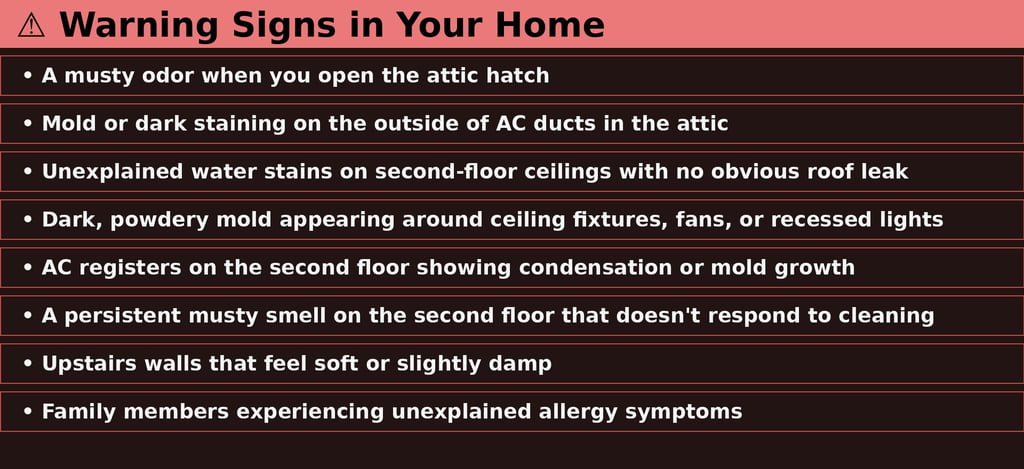
Warning Signs to Watch For in Your Home
If you live in a two-story home in The Woodlands, Conroe, Spring, Tomball, Magnolia, or Willis — particularly within a few miles of Lake Conroe, Spring Creek, or any large drainage lake — watch for these indicators:
Any one of these warrants a professional mold assessment. Several together are a strong indicator that the Paston Effect may be at work.
Get a Proper Assessment Before Spending More on Fixes That Won't Work
The Paston Effect is one of the most under-diagnosed moisture problems in Southeast Texas, and one of the most expensive to remediate if it's allowed to progress into the wall cavities. Early identification and a properly structured remediation plan can mean the difference between a manageable attic remediation and a whole-floor gut job.
At Mold Consultant Group, we conduct licensed mold assessments that include attic inspections, moisture mapping, thermal imaging, and air sampling — giving you a complete picture of what's happening in your home and a clear, written protocol for addressing it. We are TDLR Licensed MAC #1963. We don't perform remediation and have no financial relationship with any remediation contractor, so our assessment reflects exactly what we find — nothing more, nothing less.
This information is provided for educational purposes only. For property-specific recommendations, professional mold testing is recommended.
moldconsultantgrp.com · info@moldconsultantgrp.com
Inspect · Test · Guide














You Might Also Like
More from Mold Consultant Group — resources to help you understand mold, protect your home, and navigate the Texas licensing process.
Why You Should Not Use Bleach for Mold Removal
Bleach hides mold, it doesn't remove it. Learn why EPA and OSHA advise against bleach on porous surfaces — and what actually works.
How to Read Your Mold Lab Report
Spore counts, species names, outdoor baselines — a plain-English breakdown of every section of your mold test results.
Mold Clearance Reports and the Texas CMDR
What a Certificate of Mold Damage Remediation is, why it matters for real estate and insurance, and who can legally issue one in Texas.
Texas Mold Testing and Remediation Licenses Explained
MAC, MAT, MRC — what each license covers, what they can legally do, and how to verify a contractor before you hire.
The Difference Between a Mold Inspector, Assessor, and Remediator in Texas
Not all mold professionals are equal under Texas law. Understanding these distinctions protects you from hiring the wrong person.
Indoor Air Quality Testing and Mold Services
Beyond mold — how air quality testing identifies the full range of indoor contaminants affecting your home or business.
Mold Consultant Group
Independent Mold Testing & Iinspection in The Woodlands, TX.
TDLR Licensed MAC #1963.
PO Box 206, Montgomery TX 77356
Company
Hours
Mon–Thu: 9AM–5PM
Friday: 9AM–4PM
Saturday: By Appt
© 2026 Mold Consultant Group, LLC. All rights reserved.
Privacy Policy · Terms of Service · Disclaimer
TDLR MAC #1963 · MRC #0223 · IICRC Master Cleaner #266