TDLR Licensed MAC #1963 · Independent · No Remediation Conflict
Schedule a Free Consultation - Call 832-280-4747
<span>Licensed Mold Testing & Inspection in The Woodlands, TX</span>
Call to Schedule 832-280-4747<a href="tel:8322804747">📞<span>Licensed Mold Testing & Inspection in The Woodlands, TX</span>
<a href="tel:8322804747">📞 832-280-4747 — Free
Mold Myths vs Facts: Understanding the Truth
Discover the truth behind common mold myths and facts. Get accurate mold information to help you differentiate between misconceptions and reality about mold issues.
HOUSTON HOME HEALTH
Brian Boone
4/10/20266 min read
By Mold Consultant Group | TDLR Licensed MAC #1963 | Serving The Woodlands, Spring, Conroe & Montgomery County, TX
Mold is one of the most misunderstood topics in home maintenance. Between internet folklore, well-meaning neighbor advice, and marketing claims from remediation companies, homeowners in The Woodlands, Spring, Conroe, and throughout Montgomery County are often working with incomplete or flat-out wrong information when they encounter a mold problem.
Here are the most common mold myths we hear — and the facts that replace them.
Myth 1 — 'If I Can't See It, There's No Mold'
MYTH: If I can't see mold, my home doesn't have a mold problem.
FACT: The majority of significant mold growth in residential homes is hidden — inside wall cavities, under flooring, in HVAC systems, and in attic spaces. Visible surface mold on a wall or ceiling is often the tip of the iceberg. In Houston-area homes where slab foundations allow ground moisture to migrate upward and high humidity creates year-round condensation risk, hidden mold is extremely common. A professional air sampling assessment measures airborne spore concentrations — detecting mold that isn't visible and quantifying the extent of the problem.
Myth 2 — 'Bleach Kills Mold'
MYTH: I can kill mold with bleach and the problem is solved.
FACT: Bleach is effective at killing mold on non-porous surfaces like tile and glass — but it does not penetrate porous materials like drywall, wood framing, grout, or insulation. On porous surfaces, the water content of bleach actually adds moisture to the material, which can promote regrowth. More importantly, bleach does nothing about the moisture source driving the mold. Without addressing the underlying moisture, any mold that appears killed will return. For any significant mold condition — anything larger than about 10 square feet — professional remediation using physical removal of contaminated materials is required under Texas law.
Myth 3 — 'All Black Mold Is Toxic Black Mold'
MYTH: If the mold is black, it's the dangerous 'toxic black mold' (Stachybotrys).
FACT: Many different mold species appear dark green, dark gray, or black in color. Cladosporium, Aspergillus niger, and several other common mold species are dark in color but are not Stachybotrys chartarum — the species typically referred to as 'toxic black mold.' Conversely, Stachybotrys itself can sometimes appear greenish or grayish. Color alone cannot identify a mold species. Only laboratory analysis of a properly collected sample can confirm species identification. This is one of the primary reasons professional assessment with accredited lab analysis is essential — visual inspection alone is never sufficient for species identification.
Myth 4 — 'New Homes Don't Have Mold'
MYTH: My home is only two years old — there can't be a mold problem.
FACT: New construction is one of the most common scenarios in which we find mold. Framing lumber enclosed before it fully dries, rain events during the framing stage, HVAC systems oversized for the floor plan (which fail to adequately dehumidify), and improper vapor barrier installation are all documented causes of mold in homes under two years old. In Montgomery County's climate and with the pace of construction in communities like Tomball, Magnolia, and The Woodlands, new construction mold is not rare. A musty odor in a new home should be investigated, not dismissed.
Myth 5 — 'A Little Mold Is No Big Deal'
MYTH: It's just a small patch — mold is everywhere, it's not worth worrying about.
FACT: Visible surface mold is often an indicator of a larger hidden problem. A small area of discoloration on a wall surface may reflect extensive growth behind the wall where moisture has been accumulating. Additionally, even small amounts of certain mold species — particularly Stachybotrys or mycotoxin-producing Aspergillus — are worth taking seriously. The appropriate response is to investigate the moisture source, assess the extent of growth, and address both — not to ignore or paint over visible growth.
Myth 6 — 'I Can Test for Mold Myself With a Kit From the Hardware Store'
MYTH: A DIY mold test kit from the hardware store will tell me if I have a problem.
FACT: DIY mold test kits using gravity-settle petri dishes will grow mold in virtually any environment — because mold spores are present everywhere. The result tells you nothing meaningful without an outdoor baseline comparison and a concentration measurement. These kits cannot identify location of growth, measure spore concentration per cubic meter, identify species, or produce results that are legally defensible for insurance or real estate purposes. A professional assessment with calibrated air sampling, outdoor baseline comparison, and accredited laboratory analysis is the only tool that produces actionable information.
Myth 7 — 'Remediation Companies Can Assess and Fix the Problem'
MYTH: I'll just call a mold remediation company — they can tell me what's there and fix it.
FACT: In Texas, mold assessment and mold remediation must be performed by separately licensed professionals under TDLR regulations. A mold remediation contractor (MRC) is not licensed to perform the assessment — only a licensed Mold Assessment Consultant (MAC) can conduct the inspection, collect samples, and write the remediation protocol. More importantly, an assessor who also performs remediation has a direct financial incentive to find more mold and recommend more extensive remediation than may be necessary. Independent assessment — where the assessor has no financial stake in the remediation outcome — is required by Texas law and is the only way to get an unbiased evaluation of what's actually present.
Myth 8 — 'Once Mold Is Remediated, It Won't Come Back'
MYTH: After remediation, my mold problem is permanently solved.
FACT: Remediation removes the mold that is present — but if the moisture source that caused the mold is not also identified and corrected, mold will return. A leaking pipe, inadequate HVAC drainage, improper exterior grading, or a failing roof flashing will continue to introduce moisture after remediation is complete. This is why a professional assessment identifies the probable moisture source as part of the findings — addressing only the mold without the moisture is incomplete remediation. Post-remediation clearance testing (PRV) by an independent MAC confirms the remediation was successful, and follow-up monitoring ensures the moisture source has been addressed.
Myth 9 — 'Mold Is Only a Problem After Flooding'
MYTH: My house never flooded, so I don't need to worry about mold.
FACT: Flooding is one source of indoor mold, but far from the only one. In The Woodlands, Conroe, and throughout Montgomery County, the most common causes of mold we find in homes that have never flooded include: HVAC condensate drain line failures, slow plumbing leaks behind walls, roof and window flashing failures, inadequate bathroom exhaust ventilation, and chronic moisture migration through slab foundations. Houston's ambient humidity alone — averaging 75% or higher year-round — creates condensation conditions that support mold growth in homes with any air sealing deficiency. A home that has never flooded is not a mold-free home by default.
Myth 10 — 'If the Smell Goes Away, the Mold Is Gone'
MYTH: The musty smell went away on its own — the mold must have dried out.
FACT: Musty odors from mold can diminish temporarily when conditions change — lower humidity, better ventilation, or seasonal changes — without the mold actually being gone. The growth may be dormant rather than dead, and will resume when moisture conditions return. Additionally, mold that is actively growing behind a wall or under flooring may not produce a noticeable odor in all conditions. The absence of a smell is not confirmation that a mold source has been resolved. Only professional air sampling and moisture assessment can confirm whether an active mold problem has been addressed.
Have a mold question that isn't covered here? Call 832-280-4747. We're happy to talk through your specific situation — no pressure, no sales pitch. Just honest answers from a licensed professional.
Mold Consultant Group, LLC | PO Box 206, Montgomery, TX 77356 | TDLR Licensed MAC #1963 | IICRC Master Cleaner #266 | Independent — No Remediation Conflict
At Mold Consultant Group, we specialize in licensed mold inspections, air quality testing, and post-remediation verification. We serve Montgomery County, The Woodlands, Conroe, Spring, Tomball, Cypress, and surrounding areas with fast, accurate, professional service.
Need a second opinion on mold in your home?
Call us at 832-280-4747 or Request an Assessment today.
Don’t trust myths. Trust the science. Trust Mold Consultant Group.
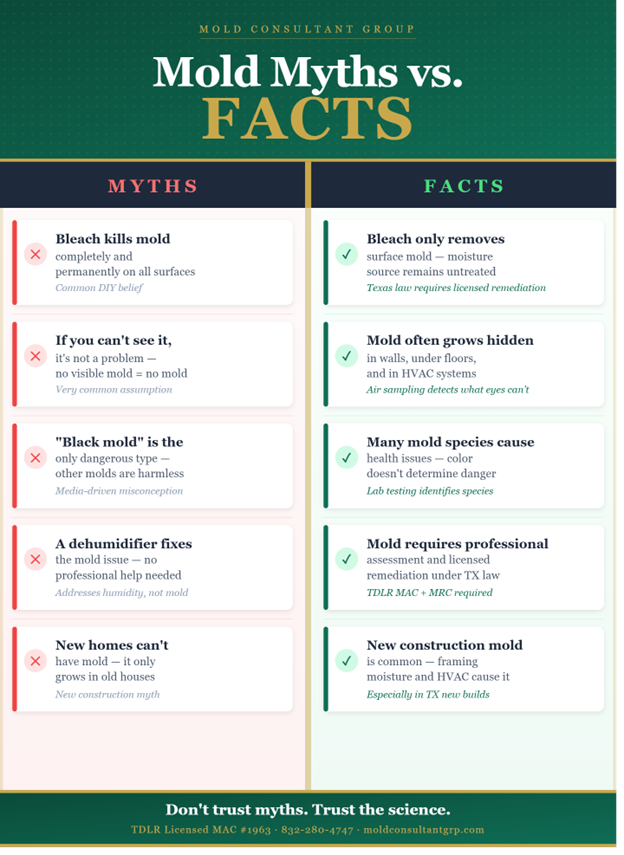
Mold Myths vs. Facts:
Think bleach kills mold? Think again.
Mold is one of the most misunderstood issues homeowners face, and unfortunately, misinformation can lead to costly mistakes—or worse, long-term health hazards. At Mold Consultant Group, we’ve seen it all. From well-intentioned DIY jobs that made things worse, to renters being told mold is “just mildew,” the myths around mold are as common as the mold itself.
Let’s clear the air (literally and figuratively) by busting some of the most common mold myths we encounter across Montgomery, The Woodlands, Conroe, and the surrounding Texas communities.
This information is provided for educational purposes only. For property-specific recommendations, professional mold testing is recommended.
You Might Also Find Helpful:
→ Using Bleach for Mold Cleaning and Removal
https://moldconsultantgrp.com/use-bleach-for-mold-cleaning-and-removal
→ Why DIY Mold Testing Kits Fall Short
https://moldconsultantgrp.com/why-diy-home-mold-testing-kits-fall-short
→ The Hidden Costs of Ignoring Mold
https://moldconsultantgrp.com/the-hidden-costs-of-ignoring-mold
Mold Consultant Group
Independent Mold Testing & Iinspection in The Woodlands, TX.
TDLR Licensed MAC #1963.
PO Box 206, Montgomery TX 77356
Company
Hours
Mon–Thu: 9AM–5PM
Friday: 9AM–4PM
Saturday: By Appt
© 2026 Mold Consultant Group, LLC. All rights reserved.
Privacy Policy · Terms of Service · Disclaimer
TDLR MAC #1963 · MRC #0223 · IICRC Master Cleaner #266