TDLR Licensed MAC #1963 · Independent · No Remediation Conflict
Schedule a Free Consultation - Call 832-280-4747
<span>Licensed Mold Testing & Inspection in The Woodlands, TX</span>
Call to Schedule 832-280-4747<a href="tel:8322804747">📞<span>Licensed Mold Testing & Inspection in The Woodlands, TX</span>
<a href="tel:8322804747">📞 832-280-4747 — Free
5 Hidden Spots Where Mold Loves to Hide - Household Mold
The most dangerous household mold is invisible. Discover 5 common hiding spots — walls, attics, flooring, appliances, and HVAC — plus warning signs to watch for
MOLD ASSESSMENT & TESTING
Brian Boone
6/4/20264 min read
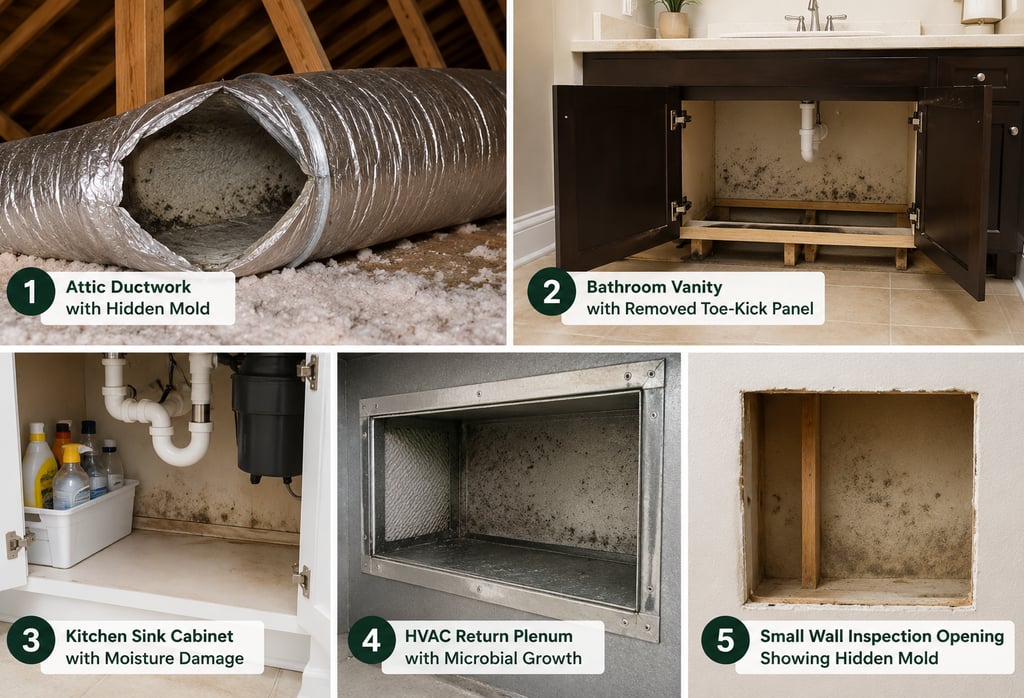
Most homeowners picture mold as something visible — the dark patch on a shower tile or the fuzzy growth on a forgotten piece of food. But in reality, the mold that causes the most damage and poses the greatest health risk is often invisible. It hides in places you rarely see, thriving behind walls, beneath floors, and inside mechanical systems while you go about your daily life without any idea it's there.
Here are five of the most common hidden mold locations we find in homes throughout The Woodlands, Spring, Conroe, and the broader Montgomery County area — and what signs might tip you off before a small problem becomes a large one.
1. Inside Walls Near Plumbing
Slow plumbing leaks — a pinhole in a supply line, a drain connection that seeps slightly, a wax ring under a toilet that's no longer sealing properly — can deposit small amounts of moisture inside wall cavities for months or even years before anyone notices. By the time the leak becomes obvious, the mold colony behind the drywall can be extensive.
Warning signs include: discoloration on walls or baseboards, paint bubbling or peeling without an obvious cause, a persistent musty smell in a bathroom, kitchen, or laundry room, and soft spots in walls or flooring. Any unexplained water stain, no matter how old it looks, deserves investigation.
2. Under Flooring After Water Events
After any water intrusion — a burst pipe, appliance overflow, flooding from a storm — moisture can migrate under hard flooring such as tile, hardwood, or laminate and saturate the subfloor underneath. Even if the surface looks and feels dry within a day or two, the subfloor and any foam underlayment may retain moisture for weeks. In a warm, humid climate like ours, that's all mold needs.
Warning signs include: flooring that begins to warp, buckle, or feel soft underfoot weeks after an event. A musty smell that seems to come from the floor level. In tiled areas, grout that discolors or cracks along seams after a water event.
3. In Attic Spaces
Attics are one of the most commonly overlooked mold locations in Texas homes. Inadequate ventilation, improperly directed bathroom exhaust fans (which vent into the attic rather than outside), and roof leaks all create the warm, moist environment that mold requires. Because attics are rarely visited, mold can grow extensively on roof sheathing and framing before anyone notices.
Warning signs include: a musty smell in upper-floor rooms or in closets on the top floor. Visible staining on ceilings. Insulation that appears compressed, wet, or discolored when accessed. An energy bill that has risen unexpectedly — compromised insulation from moisture can reduce its effectiveness.
4. Behind and Beneath Appliances
Refrigerators, dishwashers, washing machines, and ice makers all involve water. They all have supply lines, drain connections, and drain pans that can develop slow leaks over years of use. The areas immediately behind and beneath these appliances are rarely cleaned or inspected, making them ideal mold habitats.
Warning signs include: musty odor in the kitchen or laundry room that can't be traced to an obvious source. Discoloration on flooring directly in front of or around appliances. Rust spots on appliance bases or on the floor beneath them, which can indicate chronic moisture.
5. Inside HVAC Systems and Ductwork
In Southeast Texas, air conditioning systems run for a significant portion of the year. The cooling coil inside an air handler creates condensate as it cools warm, humid air — and if that drain pan or condensate line becomes restricted or develops a crack, moisture accumulates inside the unit. From there, it can spread mold spores through every room in your home every time the system runs.
Warning signs include: musty smell that is stronger when the air conditioner is running. Increased allergy or respiratory symptoms that seem tied to time spent indoors. Visible mold or staining near supply vents. A condensate drain line that is not dripping regularly during high-cooling periods may be clogged and overflowing inside the unit. Locate your secondary drain line (usually a PVC pipe) that sticks out an exterior wall of the building.
What to Do If You Suspect Hidden Mold
A musty smell without visible mold is one of the most common reasons homeowners contact us. Air sampling and surface testing can identify elevated mold spore levels and help pinpoint their likely source — even when nothing is visible. If you're concerned about any of these areas in your home, or if you've had any past water event, an independent assessment is the most reliable path to answers.
Mold Consultant Group provides licensed mold inspections and air quality testing throughout The Woodlands, Spring, Conroe, and Montgomery County. Reach us at 832-280-4747 or moldconsultantgrp.com.
This information is provided for educational purposes only. For property-specific recommendations, professional mold testing is recommended.
The 5 Hidden Spots in Your Home Where Mold Loves to Hide - Household Mold
You Might Also Like
More from Mold Consultant Group — resources on finding, testing, and properly addressing household mold.
Flooded and “Fixed”: Improper Flood Remediation in Houston Older Homes
Wall cavities, crawl spaces, and HVAC ducts are exactly the hidden spots flooding contaminates most. Why incomplete flood remediation leaves them active.
The Paston Effect — Attic Mold in Hot Humid Climates
The attic is one of the 5 hidden spots — and the Paston Effect explains exactly why two-story Houston homes are so vulnerable to mold forming where you can’t see it.
How to Read Your Mold Lab Report
Once hidden mold is found and tested, you’ll get a lab report. This plain-English guide explains every section so you understand what the results mean.
Why You Should Not Use Bleach for Mold Removal
Found mold in one of these hidden spots and reaching for bleach? Learn why bleach fails on porous surfaces and often makes the problem worse.
Mold Clearance Reports and the Texas CMDR
If hidden mold is found and remediated, the CMDR is the official Texas document confirming the work was done to standard. Here’s what it covers and why it matters.
Texas Mold Testing and Remediation Licenses Explained
Before hiring anyone to assess or remediate hidden mold, know what TDLR licenses are required in Texas and how to verify them.
Mold Consultant Group
Independent Mold Testing & Iinspection in The Woodlands, TX.
TDLR Licensed MAC #1963.
PO Box 206, Montgomery TX 77356
Company
Hours
Mon–Thu: 9AM–5PM
Friday: 9AM–4PM
Saturday: By Appt
© 2026 Mold Consultant Group, LLC. All rights reserved.
Privacy Policy · Terms of Service · Disclaimer
TDLR MAC #1963 · MRC #0223 · IICRC Master Cleaner #266